Summer 2023 Anime That Shook the Fandom: How a Season Redefined Modern Classics (WIP)
The anime community was greatly affected by the Summer 2023 anime season, especially Jujutsu Kaisen Season 2, which included the crucial “Hidden Inventory” and “Shibuya Incident” arcs. With its intense narrative and smooth animation, this season made characters like Gojo Satoru and Geto Suguru iconic, drawing in both new and devoted viewers. The season's popularity sparked a resurgence of fan art, cosplay, and conversations at conventions and online, proving that a well-done sequel can elevate a franchise's heritage and establish a new benchmark for shounen anime.
Here is the anime that released during Summer 2023 season:

Horimiya: Piece
- Aired: July 1, 2023 - September 23, 2023
- Total Eps: 13 episodes
- Streaming Platforms: -
- Studio: CloverWorks
- Director(s): Masashi Ishihama
- Original Creator: Daisuke Hagiwara
- Genre: Romance
Review: This anime is a curious artifact: a supplementary season that exists specifically to fill in the gaps left by its predecessor's breakneck pacing. The result is a warm, fragmented, and often delightful collection of vignettes that deepens the world of Katagiri High, even if it never quite coheres into something that stands entirely on its own.
The premise is straightforward. The original 2021 adaptation, in its rush to condense a lengthy manga into a single cour, excised vast swathes of character interaction and side stories. This season returns to those discarded chapters, animating the school trip, the sports festival, sleepovers, and Valentine's Day escapades that the first season skipped over. The thirteen episodes are structured as standalone "pages," each focusing on a different slice of daily life—some centered on the central couple, others on the expansive supporting cast.
The series is at its most charming when it leans into the quiet, observational humor that made the original appealing. Episodes like the kotatsu gathering, where half the cast inexplicably gravitates toward the warmth of the Hori family's living room, capture a specific, cozy texture of teenage life. The sleepover episode, in which Sengoku attempts to uncover Miyamura's secret and instead stumbles into a mortifying misunderstanding, is a genuine comedic highlight. These moments work because they trust the characters to be funny simply by existing in proximity to one another.
The expanded focus on the supporting cast is a double-edged sword. Characters like Sakura, Yanagi, and even the teachers receive dedicated episodes that grant them interiority they largely lacked in the main series. For viewers who invested in the ensemble, this is a welcome correction. For those primarily attached to Hori and Miyamura, however, the scattered attention can feel like a dilution. The central couple's dynamic remains as sweet and occasionally prickly as ever, but they are frequently relegated to supporting players in their own show.
Visually, the production maintains the clean, bright aesthetic of the original, with expressive character animation that carries the lighter tone well. The direction understands that these are low-stakes stories, and it wisely avoids overcomplicating them. The opening theme by Omoinotake sets an appropriately gentle mood. The lack of dramatic stakes, however, means the series lacks the momentum that drove the first season's central romance. There are no major revelations here, no pivotal relationship milestones—only the accumulated texture of ordinary days.
This is ultimately the season defining limitation. It is a companion work, not a standalone experience. Without familiarity with the original series and its characters, the emotional resonance of these vignettes is largely inaccessible. The show assumes affection rather than earning it, and those who never connected with the first season will find little here to change their minds. For those who did, however, it functions as a pleasant return visit to a world that ended too soon—a chance to spend a little more time with characters who feel like old friends, even if nothing particularly eventful happens while you're there.
A warm and frequently funny supplement that corrects the original's omissions, this season is best appreciated as an extended epilogue—charming in its small moments, but dependent on prior investment and unlikely to win over skeptics.
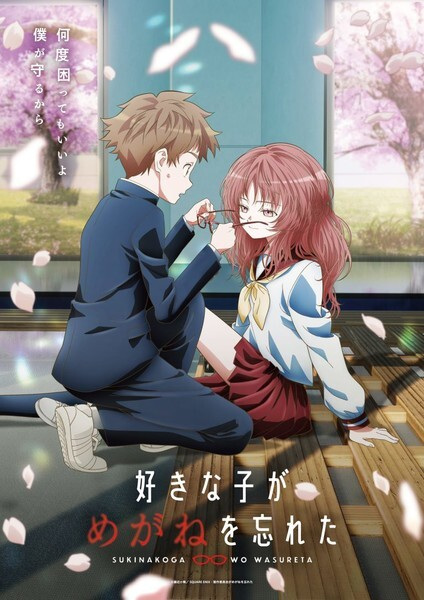
Suki na Ko ga Megane wo Wasureta
- Aired: July 4, 2023 - September 26, 2023
- Total Eps: 13 episodes
- Streaming Platforms: Crunchyroll
- Studio: GoHands
- Director(s): Susumu Kudo (Chief Director), Katsumasa Yokomine
- Original Creator: Koume Fujichika
- Genres: Comedy, Romance
Review: This anime is an adaptation of Koume Fujichika's manga built on a premise so slender it practically dares the production to justify its existence. A shy middle school boy, Komura, sits next to his crush, Mie, who habitually forgets her glasses and must rely on him to navigate the school day. The setup is designed for exactly one type of scene: Mie leans in close to see Komura's face, and Komura's heart rate spikes. Thirteen episodes of this could be a pleasant, low-stakes comfort watch. What the anime actually delivers is a visually aggressive, frequently uncomfortable experience that actively works against the modest charms of its source material.
The most immediate and inescapable issue is Studio GoHands' direction. The studio has a distinctive house style, and here it is applied with a baffling lack of restraint to material that calls for none of it. Simulated camera swoops careen around classrooms, digital filters bathe scenes in sickly yellows and blues, and CG backgrounds clash with the hand-drawn character art. Dust motes drift through CGI hallways with distracting persistence. Metal surfaces reflect light from nonexistent sources. The result is a show that is exhausting to look at, not because it is ugly in a conventional sense—there is clearly effort and budget on display—but because every frame insists on calling attention to itself when the story demands the opposite. A simple romantic comedy about a girl who cannot see properly should not feel like a migraine simulator.
The direction also does the characters no favors. Komura's internal monologue, which in the manga reads as the endearing overthinking of a nervous adolescent, is rendered here as repetitive and occasionally creepy. Mie, meanwhile, comes across less as a charmingly absent-minded girl and more as functionally helpless, a portrayal that drains the relationship of any equilibrium. The pacing compounds these issues; early episodes are padded with flashbacks to scenes that aired minutes prior, suggesting a production that burned through its resources on the showy camera work and had little left for basic narrative economy.
And yet, buried beneath the visual noise, the core premise retains a certain low-key appeal. The manga's fans point to the sweetness of Komura's earnest desire to be someone Mie can depend on, and the gradual, believable development of mutual feelings. There are moments in the anime where this shines through—a shared textbook, a quiet walk home—and one can glimpse the gentle, uncomplicated romance that might have been. The voice performances are serviceable, and when the camera settles long enough to allow a scene to breathe, the show briefly becomes watchable.
The fundamental problem is that the adaptation mistakes adornment for substance. A story this thin lives or dies on the warmth of its execution, on the viewer's willingness to invest in two awkward kids fumbling toward each other. GoHands' relentless visual pyrotechnics do not enhance that warmth; they smother it. The show is less a romance than a demonstration reel for techniques that should have been left in the studio.

Yumemiru Danshi wa Genjitsushugisha
- Aired: July 4, 2023 - September 19, 2023
- Total Eps: 12 episodes
- Streaming Platforms: Netflix
- Studios: Studio Gokumi, AXsiZ
- Director(s): Kazuomi Koga
- Original Creator: Okemaru
- Genres: Comedy, Romance
Review: This anime is built on a premise that sounds like a subversion of the standard romantic comedy formula: a boy who has spent months persistently pursuing a classmate suddenly realizes he is being a nuisance, resolves to stop, and begins keeping his distance—only for the girl to start noticing him precisely because he has stopped. In theory, this reversal of pursuit could yield a thoughtful or at least gently amusing story about self-awareness and misread signals. In practice, the twelve-episode adaptation from Studio Gokumi and AXsiZ squanders that premise through incoherent characterization, flat production values, and a fundamental failure to make either lead feel like a coherent person.
The central problem is Wataru Sajou himself. The series opens with him acknowledging that his behavior toward Aika Natsukawa amounted to stalking, and that recognition should be the foundation for genuine growth. Instead, the narrative treats his years of unwanted attention as harmless persistence that the entire class found endearing, and Aika's discomfort as a tsundere facade hiding secret affection. This framing is deeply uncomfortable. Wataru's "realism" is not maturity but a sulky retreat, and the show never reckons with the harm of his prior conduct or offers a convincing reason for Aika's sudden interest beyond the lazy logic that playing hard to get works. Aika herself remains opaque; her interiority is gestured at but never developed, leaving her motivations feeling arbitrary and her character defined almost entirely by reactions to Wataru.
The production compounds these narrative issues. The animation is consistently flat, with off-model character art and a visual presentation that feels under-resourced even by the modest standards of the genre. The school uniforms clash, the backgrounds are inert, and the direction lacks any sense of comedic timing or visual wit. Dialogue scenes drag with a stilted quality that makes even simple exchanges feel labored, and the music is forgettable at best, actively grating at worst. For a series whose appeal should rest on the small, warm moments between two people fumbling toward understanding, the inability to render those moments with any visual or emotional clarity is fatal.
There are fleeting suggestions of what might have been. Kei, Aika's best friend, occasionally cuts through the haze with a sharp observation or a teasing remark, and the show is briefly watchable whenever she is on screen. The core conceit—that both parties believe their feelings are unrequited, and that Wataru's withdrawal accidentally creates the space for Aika to examine her own—retains a sliver of potential. But the execution never capitalizes on it. Subplots involving other girls' problems and a bizarre detour with an older student's fake flirtation serve only to pad the runtime and dilute whatever focus the story might have had.
This anime is not merely a disappointing adaptation; it is a case study in how a workable premise can be undone by a production that neither understands nor cares to understand its own characters. The romantic tension it attempts to build rests on a foundation of normalized harassment and unexplored motivations, and the craft on display offers no compensatory pleasures.

Watashi no Shiawase na Kekkon
- Aired: July 5, 2023 - September 20, 2023
- Total Eps: 12 episodes
- Streaming Platforms: Netflix
- Studio: Kinema Citrus
- Director(s): Takehiro Kubota
- Original Creator: Akumi Agitogi
- Genres: Drama, Fantasy, Romance
Review: The first season arrives dressed in the trappings of a Cinderella story: a neglected daughter, a cruel stepfamily, an arranged marriage to a man rumored to be a monster. What the twelve-episode first season actually delivers is something more patient and more uneven—a study of how a person who has been taught she is worthless might, very slowly, begin to believe otherwise, wrapped in a Taisho-era fantasy of supernatural abilities and political intrigue.
The season's greatest strength is its commitment to Miyo's interiority. Her transformation from a servant in her own home to the bride of Kiyoka Kudo is not treated as a sudden rescue but as a halting, often painful process. She apologizes reflexively, expects punishment for minor errors, and struggles to accept kindness as anything other than a prelude to disappointment. Kinema Citrus' animation and Evan Call's score support this emotional register with considerable care; the palettes are soft and deliberate, and the music knows when to recede rather than swell. The early episodes, in which Miyo and Kiyoka establish a tentative domestic rhythm, are the season at its most assured.
The fantasy elements, however, prove to be a double-edged sword. The introduction of supernatural abilities and the political machinations surrounding them expands the world but also pulls focus away from the relationship that anchors the story. In the latter half, Miyo and Kiyoka share less screen time as family conspiracies and the Saimori household's schemes take center stage. The reveal that Miyo possesses a rare power—the "Dream-Sight" her mother sealed away—is meant to be empowering, but the execution ties her growth to a hereditary gift rather than to the hard-won self-worth the earlier episodes had been building. It is a shortcut that undercuts some of the season's most compelling work.
Kiyoka himself remains something of a closed book. He is kind, patient, and unfailingly considerate, which makes him an appealing contrast to the men who surround Miyo, but the season offers little insight into his own interiority or the burdens that shaped him. The supporting cast, particularly Miyo's abusive stepsister Kaya, functions largely as obstacles rather than characters with their own coherent motivations. The season's central conflict—whether Miyo can escape the gravitational pull of her family's cruelty—is resolved with a neatness that feels earned in emotional terms but rushed in narrative ones.
The final episodes, in which Miyo confronts her past self within a dreamscape to reach a wounded Kiyoka, represent the series' attempt to synthesize its romantic and fantastical threads. The result is visually striking but thematically muddled; the metaphor of overcoming one's own self-loathing is potent, yet it arrives after several episodes of political maneuvering that diluted the intimacy the story had built. What lingers is not the supernatural climax but the quieter moments: Miyo learning to accept a gift without flinching, a shared meal, a hand extended without expectation.

Zom 100: Zombie ni Naru made ni Shitai 100 no Koto
- Aired: July 9, 2023 - December 26, 2023
- Total Eps: 12 episodes
- Streaming Platforms: Crunchyroll
- Studio: BUG FILMS
- Director(s): Kazuki Kawagoe
- Original Creator: Haro Aso
- Genres: Comedy, Suspense
Review: This anime hinges on a premise that is either brilliantly cynical or deeply depressing, depending on the day: a young man is so thoroughly crushed by his corporate job that a zombie apocalypse feels like a promotion. Akira Tendo, twenty-four and hollowed out by a black company that works him to the bone, greets the end of the world with a grin because it means he no longer has to clock in. The series then follows his quest to complete a hundred experiences before he inevitably joins the undead, accompanied by a growing band of survivors who each find their own strange liberation in the collapse of society.
The opening episodes are genuinely electric. BUG FILMS, a relatively new studio, delivers animation that is fluid, expressive, and alive in a way that few television productions manage. The decision to render zombie gore as splashes of vivid paint rather than realistic viscera is a stylistic masterstroke, transforming what could be grim into something almost joyous. The first episode in particular functions as a near-perfect short film, capturing the specific misery of Japanese office culture with a precision that makes Akira's euphoric rebellion feel earned rather than merely absurd. The premise resonates because the horror of the zombie outbreak is immediately legible as a metaphor for the horror of a life spent in service of a company that views employees as disposable.
The central problem is sustainability. Once the novelty of Akira's liberation wears off, the series must build something durable from its premise, and it struggles. The bucket list structure, initially a clever engine for episodic adventures, becomes formulaic; each episode checks off an item with diminishing returns. The supporting cast, particularly Shizuka, the reserved and hyper-competent survivor who joins Akira and his best friend Kencho, is introduced with promise but develops slowly. Kencho, whose defining trait is a willingness to strip naked at any opportunity, wears thin quickly. The series wants to be a comedy, an action show, and a meditation on what makes life worth living, but it rarely commits fully to any of these registers, resulting in a tone that drifts rather than balances.
Behind the scenes, the production itself became a grim mirror of the show's themes. The series suffered a cascade of delays, culminating in an indefinite hiatus after episode nine, with the final three episodes eventually released on Christmas Day 2023. Reports suggested an overworked staff, an irony that was not lost on observers given the anime's explicit critique of exploitative labor. The studio Shaft, initially credited as a collaborator, quietly vanished from the credits, further fueling speculation about production turmoil. This context does not change what is on screen, but it lends the show's central anger a weight that its later episodes struggle to maintain.
What endures is the first impression. This anime begins with one of the most confident and thematically cohesive premieres of its season, a burst of color and rage that understands exactly what it wants to say about work, freedom, and the strange relief of catastrophe. That it cannot sustain that energy across twelve episodes is disappointing but not entirely surprising. The bucket list, after all, is finite. The question the series never quite answers is what happens after the last item is checked.

Gamera: Rebirth
- Aired: September 7, 2023
- Total Eps: 6 episodes
- Streaming Platforms: Netflix
- Studio: ENGI
- Director(s): Hiroyuki Seshita
- Original Creator: Noriaki Yuasa, Niisan Takahashi, Masaichi Nagata, Hidemasa Nagata, Yonejiro Saito, Yonesaburo Tsukiji, Akira Inoue, Masao Yagi, Tomio Sagisu
- Genre: Sci-Fi
Review: This anime is a six-episode Netflix anime that attempts to resurrect the venerable turtle kaiju by transplanting his child-protector ethos into a Stranger Things-shaped mold. Set in the summer of 1989, the series follows four children who witness the emergence of Gamera as he battles a succession of man-eating monsters, while a skeptical military and a shadowy foundation complicate matters. The premise is sound enough for a franchise revival, and the series demonstrates genuine ambition in its human drama. The execution, however, is persistently undermined by a visual presentation that rarely rises above the functional and often sinks well below it.
The animation is the most immediate and unavoidable obstacle. Produced by ENGI with Hiroyuki Seshita directing, the series employs 3D CG for its characters and monsters against largely 2D backgrounds, and the integration is frequently jarring. Human models move with a stiffness that has drawn comparisons to PlayStation 2-era cutscenes and Robot Chicken. The kaiju fare somewhat better—their designs are detailed and faithful to their Showa-era counterparts, and the battles carry a satisfying sense of weight when they finally arrive. Yet even these sequences were reportedly cut down significantly from what the director originally storyboarded, with only a fraction of the intended fight choreography making it to the screen due to budgetary constraints. The absence of a conventional opening animation, a standard feature of Japanese television anime, is a further symptom of a production stretched thin.
What salvages the series from pure spectacle-deficit is its commitment to its human cast. The four children at the center—particularly the bond between Joe and Boko—are given backstories involving loss and absent parents that lend their friendship a poignant weight. The decision to avoid the "Kenny" archetype of the classic Gamera films, where a single child serves as the kaiju's sole confidant, and instead distribute that role across a group, allows for more varied dynamics. The adult supporting cast, including a jaded American operative tasked with overseeing the children, adds a layer of Cold War-adjacent political tension that gestures toward the complexities of U.S.-Japan military relations. The series also earns its darker moments; the violence is graphic enough to unsettle, and the climax reportedly takes a turn that some viewers have found jarringly bleak for a Gamera story. Whether that tonal dissonance is a flaw or a feature depends on one's tolerance for a children's franchise that has grown teeth.
The music fares considerably better than the visuals. Shuji Katayama's score gives Gamera a rousing, guitar-driven motif that lends his appearances a genuine sense of event, and the WANIMA songs that bookend the series provide an energetic counterpoint to the grimness on screen. The sound design, down to Gamera's trademark roar, is handled with evident care.
Ultimately, this anime is a frustrating near-miss. The narrative skeleton is sturdier than the franchise's reputation might suggest, and the emotional beats involving the children land with more sincerity than the stiff animation deserves. But the series asks for over five hours of investment, and the visual poverty makes that a difficult ask to justify. It is a kaiju story that understands its heart but cannot find the budget or the technical means to match it.


Comments
Post a Comment