The Ultimate Guide to Fall 2025 Anime: What to Watch This Season
One of the most exciting anime seasons in recent memory is expected to occur in the fall of 2025. Regardless of your preference for slow-burning romance, shōnen combat, or a new story to lose yourself in, this roster has something to offer everyone. Every week feels like an occasion, with everything from eagerly anticipated sequels like Mushoku no Eiyuu: Betsu ni Skill Nanka Iranakatta n da ga and Taiyou yori mo Mabushii Hoshi to breathtaking new originals that are sure to steal the show. Anime is bringing the heat, the heart, and the enthusiasm this fall, so prepare by gathering your munchies and clearing your watchlist.

Cat's♥Eye
- Aired: September 26, 2025 - January 30, 2026
- Total Eps: 12 episodes
- Streaming Platforms: Disney+
- Studio: LIDENFILMS
- Director(s): Yoshifumi Sueda
- Original Creator: Tsukasa Hojo
- Genres: Action, Adventure, Comedy, Mystery, Romance
Review: The 2025 remake of this anime is a twelve-episode reimagining that updates Tsukasa Hojo's classic tale of art-thieving sisters for the modern era. While it successfully revives the franchise with a fresh coat of paint and a stellar soundtrack, it ultimately struggles to capture the suspense and depth that made the original concept compelling.
The series follows the Kisugi sisters—Hitomi, Rui, and Ai—who run a café by day and operate as the elusive thief trio "Cat's Eye" by night, stealing art connected to their missing father . The central tension remains Hitomi's secret relationship with Detective Toshio, who is tasked with capturing the very thieves he is dating . At its core, the show attempts to balance lighthearted romantic comedy with the thrill of high-stakes heists.
The most immediate shortcoming lies in its pacing and treatment of the heists themselves. For a show centered on cat burglars, the actual thefts often feel rushed and lack genuine tension. With only twelve episodes to work with, the narrative rarely spends more than a few minutes on any single caper, leaving little room for the intricate planning or suspenseful execution that the premise demands. The lack of disguises and the sheer improbability of Toshio never recognizing the sisters—despite their voices and close proximity—stretches credulity to a breaking point, sapping the scenarios of any real stakes.
Visually, the production by Liden Films is inconsistent. While some scenes look polished, the animation quality fluctuates, and certain CGI sequences feel jarring and out of place. The character designs, while updating the sisters for a contemporary audience, occasionally lack the distinctive sharpness of Hojo's original art, leading to moments that feel generic rather than stylish.
However, the series is not without its charms. The voice cast delivers solid performances, bringing warmth to the sisters' dynamic and effectively conveying Hitomi's internal conflict. The modern setting is handled competently, and the inclusion of cell phones is a sensible update without overwhelming the classic feel. Furthermore, the musical contributions are a standout; Ado's covers of "Magic" and "Cat's Eye" inject a burst of energy that pays homage to the 80s while feeling fresh. The dynamic between the sisters is enjoyable, and for newcomers to the franchise, it serves as a breezy, digestible introduction to the characters.
Ultimately, the 2025 Cat's Eye lands as a middling effort. It is neither a disastrous misstep nor a triumphant revival. It functions best as a light, nostalgic diversion, but those seeking the clever heists or the emotional weight of a double life may find it lacking. It offers a pleasant enough time, but it rarely leaves a lasting impression.

Let's Play: Quest-darake no My Life
- Aired: October 2, 2025 - December 18, 2025
- Total Eps: 12 episodes
- Streaming Platforms: Crunchyroll
- Studio: OLM
- Director(s): Daiki Tomiyasu
- Original Creator: Mongie
- Genres: Comedy, Romance
Review: The 2025 anime adaptation of famous webtoon arrives with considerable baggage: it is based on a hugely popular American webcomic by Mongie, and transplanting that distinctly Western, online-native sensibility into a Japanese anime production proves to be both its most intriguing experiment and its most persistent stumbling block. The result is a series that is frequently charming and occasionally frustrating, a slow-burn romantic dramedy that never quite decides whether it wants to be a gaming story, a mental health character study, or a conventional office romance.
The premise is built on a sharp, modern hook. Sam Young is a young game developer whose debut title, Ruminate, is savaged in a viral review by popular streamer Marshall Law. The humiliation compounds when Marshall moves into the apartment next door, forcing the two into an awkward proximity that gradually shifts from antagonism toward something more complicated. It is a setup ripe for tension and humor, and the early episodes lean into the cringe-comedy of Sam's social anxiety colliding with Marshall's oblivious bluntness. Where the series diverges from expectations is in its refusal to stay a simple rivals-to-lovers story; it expands into a broader ensemble, introducing Charles, Sam's boss and a paternal figure; Link, a childhood friend with his own unspoken feelings; and a supporting cast each grappling with their own emotional baggage.
That ambition to be more than a rom-com is both admirable and unevenly executed. The most distinctive element carried over from the webcomic is the visual personification of mental health struggles: characters' anxieties and traumas manifest as shadowy creatures that follow them, interact, and occasionally combine into more complex psychological "bosses". It is a genuinely inventive metaphor, and when the series pauses to explore it, the emotional register deepens in ways that feel earned. Unfortunately, the twelve-episode runtime—reportedly shortened from an intended longer order—forces the narrative to rush through these arcs, leaving several characters and their internal conflicts feeling sketched rather than fully realized. The ensemble is introduced almost all at once, and the result is a cast that feels crowded rather than rich, with Sam herself often lacking the distinct interiority that would justify the intense devotion she inspires from those around her.
Visually, the adaptation struggles to bridge its source material's aesthetic with anime convention. The character designs sand down the edges of Mongie's original art, making the cast look noticeably younger and softer than their webcomic counterparts. This is not merely a cosmetic complaint; it undercuts the story's grounding in adult concerns—career setbacks, workplace dynamics, and the messy aftermath of public failure—by presenting characters who read as teenagers navigating high-school drama. The animation itself is serviceable but rarely expressive, and the direction lacks the visual wit that might have compensated for the compressed storytelling. The soundtrack is similarly forgettable, though the opening and ending sequences show flashes of stylistic personality.
What ultimately saves the series from feeling like a wasted opportunity is its sincerity. For all its pacing problems and tonal inconsistencies, this anime genuinely cares about its characters' emotional lives. The romance, when it finally crystallizes, has a sweetness that feels earned rather than manufactured, and the show's commitment to depicting anxiety and self-doubt as tangible, external forces remain its most distinctive asset. The decision to set the story in Los Angeles and largely respect its American context—rather than Japanify its wholesale—is also a welcome departure from convention, even if the execution occasionally reveals the seams of a Japanese production team interpreting American life.
This is not a series that will satisfy audiences seeking either a propulsive gaming narrative or a tightly plotted romance. It is a flawed but earnest adaptation that captures the spirit of its source while struggling under the constraints of its format. Those willing to meet it on its own terms—forgiving the uneven pacing and the softened character designs—will find moments of genuine warmth and a refreshingly non-Japanese perspective on familiar anime tropes. Those unfamiliar with the webcomic may wonder what all the fuss is about; those who love it will likely see both what the anime gets right and what it loses in translation.
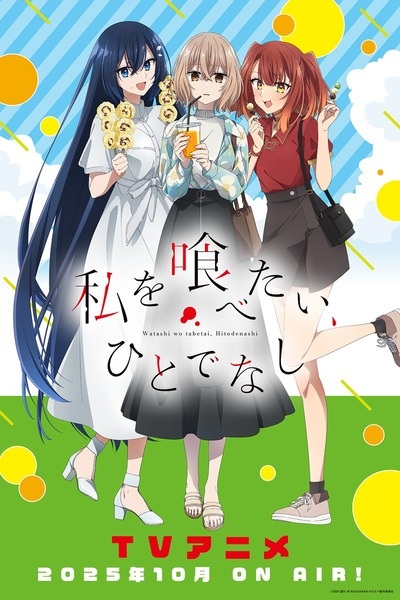
Watashi wo Tabetai, Hitodenashi
- Aired: October 2, 2025 - December 25, 2025
- Total Eps: 13 episodes
- Streaming Platforms: Crunchyroll
- Studio: Studio Lings
- Director(s): Naoyuki Kuzuya (chief), Yūsuke Suzuki
- Original Creator: Sai Naekawa
- Genres: Drama, Girls Love, Supernatural
Review: This 2025 anime adaptation is a work defined by a striking and unsettling contradiction. It pairs gorgeous, melancholic visuals with a premise steeped in profound despair, crafting a yuri story that is less about romance and more about the gravitational pull between trauma and oblivion. The series is frequently haunting and emotionally resonant, but its uneven pacing and occasional tonal missteps keep it from fully realizing its considerable potential.
The story centers on Hinako Yaotose, a high school girl whose family died in an accident, leaving her with a pervasive death wish. Her quiet longing for oblivion is interrupted by Shiori, a mermaid-like yokai who announces her intention to eventually devour Hinako. Until that day comes, Shiori appoints herself as Hinako's protector against other supernatural threats. This central pact forms the backbone of the narrative, a slow-burn dynamic where affection and predation are impossibly intertwined. The series is at its most compelling when it leans into this inherent toxicity. Shiori is a genuinely unsettling figure—alien and menacing, yet capable of a strange, possessive tenderness. The bond between the two is a fragile, destructive thing, and the show is unafraid to explore the uncomfortable space where a desire to protect someone coexists with a desire to consume them.
Where the series excels most is in its visual and atmospheric commitment to Hinako's internal state. The direction frequently employs water as a potent metaphor for her depression and dissociation, submerging the audience in her suffocating isolation. The muted color palette and the haunting, string-heavy soundtrack reinforce a pervasive sense of melancholy that never feels cheap or exploitative. This commitment to a somber tone is admirable, particularly for a genre that often defaults to levity. The depiction of depression, while sometimes repetitive, carries a weight that feels authentic, particularly in its portrayal of survivor's guilt and the exhausting effort of simply existing in a world that continues to move on.
However, the series struggles to maintain its focus and momentum. The pacing is a significant issue, with the middle stretch feeling notably padded. The narrative frequently stalls, revisiting the same emotional beats without advancing the characters or the plot in meaningful ways. A more disciplined approach, perhaps condensing the story into a tighter arc, might have preserved the intensity of the central dynamic. The introduction of Miko, a third major character, adds a necessary counterpoint to Shiori's darkness, but the resulting love triangle often feels underdeveloped, with the show unsure of how much time to devote to each relationship.
The tonal balance is another persistent stumbling block. The series occasionally injects moments of broad comedy that clash violently with the otherwise oppressive atmosphere. While these lighter scenes are presumably intended to offer relief, they often undercut the tension the show has worked so hard to build, creating a jarring emotional whiplash. The show is at its best when it trusts its audience to sit with the discomfort, rather than trying to defuse it with an ill-timed joke.
Ultimately, this anime is a flawed but frequently mesmerizing experience. It is a bold and often beautiful exploration of grief and desire that refuses to offer easy answers. For audiences willing to engage with its heavy themes and forgive its narrative stumbles, it offers a genuinely unique and emotionally taxing journey. It is not a comfortable watch, nor is it a perfectly constructed one, but its haunting imagery and the tragic, twisted bond at its center linger long after the final episode.

Bukiyou na Senpai.
- Aired: October 2, 2025 - December 18, 2025
- Total Eps: 12 episodes
- Streaming Platforms: Crunchyroll
- Studio: Studio Elle
- Director(s): Ayumu Kotake
- Original Creator: Makoto Kudo
- Genres: Comedy, Romance
Review: This 2025 anime adaptation arrives as a workplace romantic comedy with a genuinely appealing central premise, only to spend much of its twelve-episode run undermining its own strongest asset. The series is anchored by Azusa Kannawa, a competent marketing manager whose severe social awkwardness is consistently mistaken for strictness by her colleagues. When she is assigned to train the new hire, Yuu Kamegawa, the two begin a tentative, halting dance toward something more than a professional relationship. It is a setup that promises the rare pleasure of an adult romance grounded in office life, but the execution too often retreats into the rhythms of a high-school courtship, leaving the workplace setting as little more than wallpaper.
The show's greatest strength is Kannawa herself. She is written and performed with a specificity that elevates her above the standard awkward-heroine archetype. She is not merely clumsy or shy; she is a capable professional whose inability to navigate casual social interaction creates a constant, low-grade friction between her competence and her vulnerability. The series wisely avoids turning her into either a tyrant or a helpless moe figure, instead presenting her as someone who simply cannot bridge the gap between her internal intentions and her external presentation. Her gradual, painfully slow opening up to Kamegawa provides the emotional core that keeps the series watchable even when the plot stalls.
That stall is the primary issue. The first several episodes establish the dynamic effectively, but the middle stretch becomes noticeably repetitive, treading water with near-misses and misunderstandings that feel increasingly contrived given that both characters are ostensibly adults in a professional environment. The relationship advances at a glacial pace, and the show's insistence on maintaining a "just friends" status long past the point of plausibility grows frustrating. A beach trip and other standard romantic comedy beats are introduced, but they feel obligatory rather than organic, inserted to fill runtime rather than to develop the characters. The eventual confession, when it arrives, is staged with a theatrical awkwardness that some audiences will find charming and others will find exhausting, particularly given the characters' stated ages and professional standing.
Kamegawa is the weaker half of the central pair. He is supportive, patient, and almost entirely devoid of interiority. His function is to be present, to be kind, and to occasionally say something that makes Kannawa flustered. He has no discernible flaws or goals beyond his relationship with his senpai, which renders him more of a narrative device than a character. This imbalance means the romance feels one-sided in a way that undercuts its sweetness; the audience is asked to root for a couple where only one person has been given a personality.
Visually, the production is serviceable but unremarkable. The character designs are pleasant, though the dual-tone hair colors are an odd choice that distract more than they endear. The animation does not rise to the level of expressive comedy that the premise could support; Kannawa's awkwardness is conveyed more through dialogue and voice performance than through visual inventiveness. The office environment is rendered with adequate detail, but the series never seems interested in using the workplace as anything more than a convenient meeting point. The professional dynamics that could have enriched the story—the pressures of management, the negotiation of hierarchy, the genuine stakes of work—are largely absent.
What ultimately makes this anime worth watching for genre fans is its sincerity. It is not a cynical show, and it clearly cares about Kannawa's emotional journey. The quieter moments, particularly those that explore her relationship with her mother or her halting attempts to connect with colleagues beyond Kamegawa, carry a genuine warmth. For audiences seeking a gentle, low-stakes romance with an endearing lead, the series delivers enough to justify its runtime. But those hoping for a meaningful exploration of adult relationships or a nuanced portrait of workplace life will find the show's refusal to engage with those possibilities its most significant shortcoming. It is a sweet diversion that never quite becomes the story its premise promised.
A charming but frustrating office romance that is elevated by a genuinely endearing lead and undermined by glacial pacing, a forgettable male lead, and a refusal to engage with its own adult setting.

Nohara Hiroshi: Hiru Meshi no Ryuugi
- Aired: October 3, 2025 - December 19, 2025
- Total Eps: 12 episodes
- Streaming Platforms: Netflix
- Studio: DLE
- Director(s): Tsukasa Nishiyama
- Original Creator: Yōichi Tsukahara
- Genres: Comedy, Gourmet

Saigo ni Hitotsu dake Onegai shitemo Yoroshii deshou ka
- Aired: October 4, 2025 - December 20, 2025
- Total Eps: 13 episodes
- Streaming Platforms: Crunchyroll
- Studio: Liden Films
- Director(s): Kazuya Sakamoto
- Original Creator: Nana Ōtori
- Genres: Action, Comedy, Fantasy, Romance
Review: This anime opens on a scene that has become familiar to anyone versed in the "villainess" subgenre: a broken engagement, a public accusation, a room full of sneering nobles. What follows is not the usual patient scheming or quiet reclamation of dignity. Scarlet el Vandimion, falsely branded a brute and discarded by the second prince, asks only for one last request before she leaves—and then proceeds to beat him and his entire faction bloody with her bare fists. The series that unfolds from this premise is less interested in courtly intrigue than in the simple, visceral satisfaction of watching a woman who has endured a decade of humiliation finally hit back.
That bluntness is both the work's defining charm and its ceiling. The narrative does not pretend to moral complexity. The nobles who side with Prince Kyle are uniformly corrupt, cowardly, and deserving of the pummeling they receive. The satisfaction comes from the choreography of retribution, not from any ambiguity about who deserves it. For twelve episodes, Scarlet moves through a world of scheming aristocrats with her gloves—sometimes leather biker gloves, sometimes fighting gloves, the distinction never quite clarified—and a willingness to solve problems with her fists that is genuinely uncommon for a female lead in this genre. The first prince, Julius, watches this with growing fascination, and their dynamic provides the romantic throughline: a man intrigued by a woman who is not performing fragility.
LIDENFILMS' production is competent without being remarkable. The animation holds up during action sequences, and Scarlet's character design receives visible care, with a wardrobe that shifts frequently and draws attention to her as a visual subject. The direction, credited to Kazuya Sakamoto, keeps the pacing brisk, though the series never quite escapes a sense of surface-level entertainment. The villains are so one-note in their villainy that the joy of seeing them punched diminishes as the episodes accumulate; there is only so much satisfaction to be extracted from defeating caricatures. The ending has been described as forgettable, and the world-building is left largely unexplored, gesturing toward a broader political conflict without committing to its stakes.
What lingers is Scarlet herself. Her lines are sharp, her refusal to be cowed is played without hesitation, and her physicality is treated as a legitimate form of agency rather than a punchline. The series does not ask its audience to find her likable in a conventional sense; it asks them to enjoy watching her refuse to be a victim. That is a narrower ambition than the genre's best works achieve, but within its modest scope, it delivers what it promises.

Tomodachi no Imouto ga Ore ni dake Uzai
- Aired: October 5, 2025 - December 21, 2025
- Total Eps: 12 episodes
- Streaming Platforms: Crunchyroll
- Studio: Blade
- Director(s): Kazuomi Koga
- Original Creator: Ghost Mikawa
- Genres: Comedy, Romance
Review: This anime is a twelve-episode romantic comedy from studio Blade that takes a premise with genuine potential—the playful, irritating dynamic between a serious-minded protagonist and his best friend's persistently teasing younger sister—and buries it beneath a pile of disconnected subplots, an aggressively unlikable supporting cast, and a structural incoherence that makes the title feel like false advertising. The series wants to be about Iroha's relentless provocation of Akiteru, but it spends far more time on a fake-dating arrangement with his cousin and a game-development club that never coheres into a compelling narrative.
The central failure is one of focus. The title promises a story about Iroha, the friend's little sister who reserves her most obnoxious behavior exclusively for Akiteru. What the anime actually delivers is a scattered ensemble piece in which Iroha's teasing occupies perhaps the first two episodes before the plot pivots to Akiteru's uncle offering to sponsor his game studio in exchange for pretending to date his cousin Mashiro. These three threads—Iroha's flirtation, Mashiro's fake relationship, and the game club's ambitions—never mesh. The story stutters from one vignette to the next, each feeling like it belongs to a different, equally mediocre series. The result is a show that cannot decide what it wants to be and therefore succeeds at none of its ambitions.
The character work is similarly compromised. Akiteru is ostensibly a pragmatic, efficiency-obsessed young man, but his obliviousness to Iroha's obvious feelings is played so broadly that he ceases to function as a believable human being, let alone a romantic lead. Iroha herself is less a character than a collection of teasing behaviors; her backstory, when it finally arrives in a mid-season flashback episode, reveals a genuinely poignant origin—a sheltered girl whose life was transformed by Akiteru's intervention—but this context arrives too late and is too disconnected from the present-day dynamic to retroactively justify her earlier behavior. Mashiro, the cousin and fake girlfriend, is described by multiple sources as actively annoying for much of her screen time, and the teacher, Sumire, is introduced through a blackmail subplot involving shotacon doujinshi that lands with a thud rather than a laugh.
The production values are serviceable but unremarkable. Animation is described as average—neither notably bad nor notably good—and the music is similarly functional, with the opening theme standing out primarily for its density of cultural references and a chibi Iroha dance sequence. The direction lacks the comedic timing necessary to make the teasing dynamic work; scenes that should crackle with playful tension instead feel stilted and repetitive. For a romantic comedy, the romance barely progresses across twelve episodes, and the comedy relies on the same handful of gags—Iroha's clinginess, Akiteru's exasperation, Mashiro's tsundere reticence—without variation.
What lingers, ultimately, is a sense of wasted potential. The title is genuinely good, suggesting a specific and appealing dynamic. The source material, written by the author of this anime, has demonstrated capacity for nuanced character writing. And the core idea—a boy so focused on his future that he cannot see the person right in front of him—is a sturdy foundation for a romantic comedy. But the adaptation squanders all of it. It is a series that neither commits to its premise nor finds a compelling alternative, leaving only a scattered, unfocused twelve episodes that feel considerably longer than their runtime.

Sawaranaide Kotesashi-kun
- Aired: October 6, 2025 - December 22, 2025
- Total Eps: 12 episodes
- Streaming Platforms: -
- Studio: Quad
- Director(s): Hisashi Saitō
- Original Creator: Takuya Shinjō
- Genres: Sports, Ecchi
Review: This is a twelve-episode short-form anime that operates on a premise so transparently utilitarian that evaluating it requires acknowledging what it is rather than what it could be. Kōyō Kotesashi, a high schooler with professional-grade massage skills and aspirations of medical school, is installed as the dorm manager for a house of elite female athletes. His massages, rendered with extensive nudity and vocalizations despite the ostensibly therapeutic context, form the bulk of the series' content. Produced by Quad under the Deregula label, with a censored television broadcast and an uncensored streaming version, the show makes no secret of its priorities.
The production itself is competent within its narrow parameters. Animation quality is maintained consistently across all twelve episodes, capturing the manga's character designs without noticeable degradation, and the twelve-minute episode length keeps the pacing brisk. Kotesashi as a protagonist is a deliberate departure from the harem archetype: he is focused, professionally detached, and genuinely uninterested in the romantic or sexual possibilities surrounding him. This single-mindedness has drawn praise from those who find the typical hapless lead exhausting, and it does lend the series a different texture than its peers. The girls are sketched with enough individual traits—prickliness, insecurity, competitive drive—to avoid being entirely interchangeable, though the series has little time to develop them beyond their introductory episodes.
The central issue is one of purpose and proportion. The nudity is near-constant, and the vocal responses to even minor therapeutic contact are exaggerated to a degree that strains the massage premise past its breaking point. The show sits in an uncomfortable middle ground: too explicit for conventional television, too narratively thin for the adult animation market it gestures toward. The question of why the characters are high school students rather than adults, given the content, is one the series never addresses and which casts a persistent shadow over the experience. For audiences seeking pure fan service, it delivers; for anyone seeking a story, the twelve-minute episodes offer little beyond a premise stretched across a season.
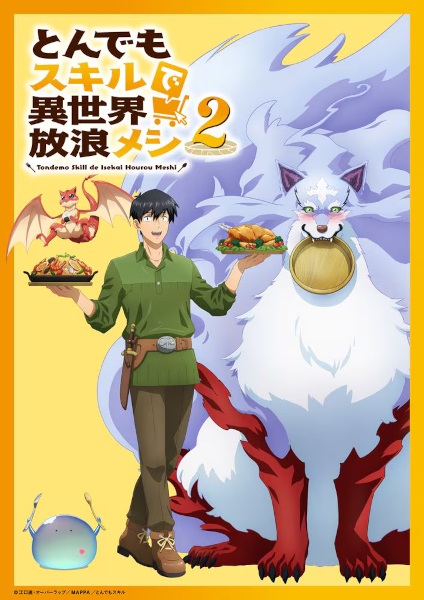
Tondemo Skill de Isekai Hourou Meshi 2
- Aired: October 8, 2025 - December 24, 2025
- Total Eps: 12 episodes
- Streaming Platforms: Crunchyroll
- Studio: MAPPA
- Director(s): Kiyoshi Matsuda
- Original Creator: Ren Eguchi
- Genres: Adventure, Comedy, Fantasy, Gourmet
Review: This anime returns with the same promise as its predecessor: a low-stakes isekai in which the greatest threat is an empty stomach and the most powerful weapon is a well-seasoned skillet. Mukohda, the salaryman summoned to another world with the useless-sounding "Online Supermarket" skill, continues his culinary journey alongside his gluttonous familiars—the legendary fenrir Fel, the adaptable slime Sui, and the newly joined pixie dragon Dora-chan. MAPPA's commitment to rendering food with almost obscene appetizing detail remains the series' defining asset, and for audiences seeking comfort rather than conflict, the second season delivers exactly what it promises. Whether that is enough depends entirely on one's tolerance for a formula that has no intention of evolving.
The production values are, if anything, more assured than in the first season. MAPPA's animation treats every dish as an event, with the sizzle of meat, the glisten of sauces, and the careful choreography of preparation receiving a level of attention that few cooking anime can match. The studio reportedly consulted with professional food coordinators and secured sponsorships from major Japanese food companies, and the result is a show that frequently feels less like fantasy and more like a cooking demonstration with magical companions . The voice cast remains comfortably settled in their roles, with Ayumu Murase's Dora-chan adding a welcome note of snarky irreverence to the group dynamic.
The central problem is one of diminishing returns. The first season established a rhythm—travel, encounter exotic ingredients, cook, feed familiars and gods, receive blessings—and the second season follows it with almost mechanical fidelity. The new addition of Dora-chan provides some initial novelty, particularly in a sequence where the dragon rationalizes eating another dragon by pointing out that they are different species. But beyond that, the show's structure remains unchanged, and the sense of discovery that animated the first season has largely dissipated.
What the series does retain is its peculiar charm as a fantasy of gentle domesticity. Mukohda is not a hero in any conventional sense; he is a provider, and the show's pleasures lie in watching him care for his found family through food. This has been noted as a refreshing alternative to the power-fantasy masculinity that dominates the isekai genre, presenting a male lead whose greatest skill is nurturing rather than destroying. The dungeon-crawling subplot that occupies part of the season gestures toward traditional adventure, but even here the emphasis remains on preparation and sustenance rather than combat. The goddesses who extort offerings in exchange for blessings remain a reliable source of comedy, their petty divine entitlement contrasting with Mukohda's weary exasperation.
The season is not without its small pleasures. The introduction of Vianca, a guild secretary with an inexplicable fondness for Fel, adds a minor but amusing thread. The lore regarding dungeons as living entities that feed on adventurers carries a faint hint of horror that the show wisely never explores too deeply. And the food, always the food, remains capable of inducing genuine hunger in even the most jaded fans.
For those who found the first season's blend of culinary spectacle and low-conflict companionship soothing, the second season offers more of the same, executed with competence and care. For those who hoped the series might grow or complicate its formula, the twelve episodes provide little reason to return. It is comfort food in the most literal sense: satisfying in the moment, nutritionally thin, and unlikely to be remembered once the plate is cleared.
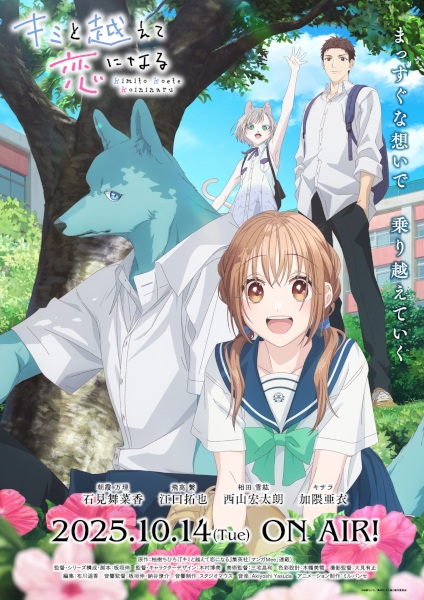
Kimi to Koete Koi ni Naru
- Aired: October 14, 2025 - December 30, 2025
- Total Eps: 12 episodes
- Streaming Platforms: Crunchyroll
- Studio: Millepensee
- Director(s): Shin Itagaki
- Original Creator: Chihiro Yuzuki
- Genres: Fantasy, Romance
Review: This is a supernatural romance that pairs a human girl with a beastman classmate, and it approaches that premise with a sincerity that is both its greatest strength and its most significant limitation. The story follows Asaka, a high schooler who finds herself drawn to Tsunagu, a quiet boy who is rumored to be a beast in human form. What unfolds is a gentle, deliberate courtship in which the central obstacle is not external threat but the couple's own uncertainty about whether they can bridge the gap between their natures. The production values are modest but the emotional register is consistent, and for audiences seeking a soft-spoken romance with a touch of fantasy, it offers a modest but genuine pleasure.
The series' handling of its supernatural element is notable for its restraint. Tsunagu's beastman nature is not treated as a metaphor for monstrosity or a source of dramatic conflict; it is simply a fact of his existence, and the story is more interested in the everyday negotiations of a relationship than in the spectacle of his otherness. This choice lends the romance a quiet intimacy that distinguishes it from more melodramatic entries in the genre. The animation, while not lavish, captures the tenderness of small gestures—a hesitant touch, a shared glance—with enough care to make the emotional beats land. The character designs are appealing, and the voice performances convey a believable awkwardness between two people who are still learning how to be close to one another.
The central weakness lies in the pacing and the thinness of the supporting cast. The series takes its time, which is appropriate for a slow-burn romance, but it occasionally mistakes stillness for depth. The world beyond the couple is sketched rather than developed, and the questions raised by Tsunagu's existence—how beastmen are integrated into society, what his future holds—are left largely unexplored. The result is a romance that feels insulated, pleasant but weightless. There are moments when the story gestures toward a larger emotional complexity, particularly regarding the fear of being seen as fundamentally different, but it never quite commits to interrogating that fear in a way that would give the series more heft.
For audiences who appreciate a romance that prioritizes gentleness over drama, this anime offers a modest reward. It is a story about two people choosing each other despite the uncertainties that surround them, and it treats that choice with respect. It is not a series that will linger long after its final episode, but while it lasts, it is a warm and unassuming companion.


Comments
Post a Comment