List of A-1 Pictures productions (Movies)
With a wide range of engaging films in addition to its many well-liked TV shows, A-1 Pictures has made a name for itself in the anime business. Even though precise box office results for all of their films are difficult to come by, the company has continuously produced highly regarded and adored motion pictures, frequently building on well-known franchises or introducing breathtaking fresh stories. Their status as a successful and major studio is mostly due to their animated features, which regularly display their distinctive fusion of excellent animation, gripping narratives, and endearing characters. In light of it, A-1 Pictures has recommended the following anime films.

Uchuu Show e Youkoso
- Aired: February 18, 2010
- Total Eps: 1 episode
- Streaming Platforms: -
- Studio: A-1 Pictures
- Director(s): Koji Masunari
- Original Creator: Hideyuki Kurata
- Genres: Adventure, Fantasy, Sci-Fi
Review: This is an ambitious, visually spectacular science-fiction adventure whose imagination frequently exceeds its narrative discipline.
Its greatest achievement lies in its extraordinary depiction of extraterrestrial civilizations. Few animated films of its period demonstrate such enthusiasm for creating a universe filled with unusual creatures, eccentric societies, and elaborate environments. The film also deserves recognition for its affectionate portrayal of childhood curiosity. Its protagonists are not heroic figures destined to save the universe but ordinary children who find themselves caught in an adventure far beyond anything they could have imagined.
Unfortunately, the film's considerable strengths are undermined by an overextended runtime, inconsistent pacing, and emotional conflicts that never become quite as compelling as its visual presentation. The screenplay repeatedly introduces fascinating ideas without always providing the narrative focus necessary to develop them effectively. As a result, the experience can feel simultaneously magical and exhausting.
Nevertheless, there is something genuinely admirable about a production willing to embrace such extravagant creativity. Even when the storytelling falters, the film rarely loses its affection for exploration, friendship, and the possibilities of an unimaginably vast universe.
Ultimately, this anime film is more successful as a celebration of animated imagination than as a tightly constructed adventure. It may not deliver the emotional resonance or narrative precision of the finest animated science-fiction films, but its extraordinary artistic ambition makes it a worthwhile experience for audiences who appreciate fantastical world-building.

Fairy Tail Movie 1: Houou no Miko
- Aired: August 18, 2012
- Total Eps: 1 episode
- Streaming Platforms: Crunchyroll
- Studio: A-1 Pictures
- Director(s): Masaya Fujimori
- Original Creator: Hiro Mashima
- Genres: Action, Adventure, Fantasy
Review: This is an enjoyable but ultimately conventional theatrical adventure that succeeds primarily through its familiar characters, energetic magical battles, and surprisingly heartfelt central storyline.
Éclair is a sympathetic addition to the franchise, and her relationship with Lucy provides some of the film's most emotionally engaging moments. The themes surrounding mortality, companionship, and the dangers of pursuing immortality also introduce a degree of seriousness that complements the franchise's usual emphasis on friendship. Visually, the film offers respectable improvements over the television series, particularly during its larger action sequences. Its colorful magical effects and dynamic confrontations provide the spectacle audiences would reasonably expect from a theatrical adaptation.
Unfortunately, the screenplay rarely demonstrates the ambition necessary to elevate these strengths into something truly memorable. The predictable storyline, underdeveloped antagonist, and rushed final act prevent the film from fully realizing its emotional and thematic potential. Furthermore, its reliance on established shonen conventions makes the experience feel somewhat redundant for fans already familiar with the television series.
Nevertheless, this film remains an entertaining addition to the Fairy Tail franchise. It understands the fundamental appeal of its source material and delivers enough humor, action, and emotional sincerity to satisfy its intended audience.
Ultimately, the film is best appreciated as a heartfelt side adventure rather than an essential chapter in the franchise's larger narrative. It may not redefine what Fairy Tail can accomplish, but it provides a reasonably satisfying reminder of why audiences became attached to its characters in the first place.

Ao no Exorcist Movie
- Aired: December 28, 2012
- Total Eps: 1 episode
- Streaming Platforms: -
- Studio: A-1 Pictures
- Director(s): Atsushi Takahashi
- Original Creator: Kazue Kato
- Genres: Action, Supernatural
Review: Set sometime after the events of the anime's first season, the film finds True Cross Academy Town preparing for a grand festival held once every eleven years. While the city's demon barriers are under repair, Rin and Yukio are dispatched to handle a berserk "Phantom Train." In the chaos, Rin encounters a young demon boy named Usamaro, who has a mysterious connection to the festival and a troubling ability to erase people's painful memories. A senior exorcist from the Taiwan Branch, Cheng-Long Liu, is also brought in, and his path crosses with Rin's as the situation escalates.
The film's greatest asset is its animation. Produced by A-1 Pictures, the movie benefits from a noticeably higher budget than the TV series, with lush background art and fluid action sequences that look striking on a larger scale. The opening action set piece, in particular, has been singled out as genuinely thrilling. The emotional heart of the story is the relationship that develops between Rin and Usamaro. Rin takes on a protective, almost parental role, and their bond gives the film a bittersweet, heartwarming quality that resonates by the finale. For fans of the series, seeing the characters again in this context is a pleasant experience, and the film's focus on memory and loss fits naturally within the Blue Exorcist world.
The story is where the film stumbles. The central plot—a mysterious child with a tragic secret who must inevitably be erased from memory—is highly predictable from the outset. This lack of surprise undermines the emotional beats, making the ending feel more manipulative than earned.
The supporting cast is largely sidelined. Aside from Rin, Yukio, and Usamaro, the other familiar characters—Shiemi, Bon, Shima, and the rest—are relegated to background jokes and brief cameos, contributing little to the narrative. The new character Cheng-Long Liu is also underdeveloped, his presence feeling somewhat arbitrary. Additionally, the film's action quotient is lower than one might expect from a shounen movie; it prioritizes sentiment over spectacle, which may disappoint viewers seeking the high-stakes battles of the series.
This movie is best approached as a bonus story for those who already love the characters. It delivers solid production values and a genuinely touching Rin-centric tale, but its predictable script and shallow use of the ensemble cast prevent it from standing alongside the best anime films. Fans of the franchise will find it a pleasant, if disposable, diversion; newcomers should start with the series' first.

Saint☆Oniisan (Movie)
- Aired: May 10, 2013
- Total Eps: 1 episode
- Streaming Platforms: -
- Studio: A-1 Pictures
- Director(s): Noriko Takao
- Original Creator: Hikaru Nakamura
- Genre: Comedy
Review: The setup is the film's biggest hook. After millennia of spiritual labor, Jesus Christ and Gautama Buddha descend to Earth for a holiday, renting a small apartment in Tokyo and attempting to live incognito. The comedy stems from the friction between their divine nature and mundane reality—Buddha's halo causing problems on trains, Jesus accidentally turning water into wine, and both of them struggling with grocery budgets and nosy landladies. The film is structured as a loose collection of sketches rather than a cohesive narrative, following the duo through amusement parks, public baths, and festivals.
The film's greatest asset is its tone. Despite the potentially controversial premise, the humor is remarkably gentle and respectful. Neither figure is mocked; instead, their established traits are playfully transposed into everyday situations. Jesus is portrayed as the more energetic and impulsive of the two, while Buddha is calm, frugal, and prone to attracting animals against his will. Their dynamic is genuinely endearing, a wholesome "bromance" that carries the film through its thinner moments. Visually, the movie stands out. A-1 Pictures employs a stylized, sketchy aesthetic with soft colors and rough linework that gives it a distinct, storybook quality unlike typical anime productions. The character designs are expressive and complement the laid-back atmosphere. Voice performances by Gen Hoshino (Buddha) and Mirai Moriyama (Jesus) are lively and well-matched to their roles.
The primary criticism is structural. The film lacks a driving plot, functioning as a series of disconnected skits of varying quality. Some segments, particularly those involving a local yakuza member or the landlady, land well; others, such as extended scenes of children bothering Buddha, feel repetitive and drag. Viewers expecting a traditional narrative arc will likely find the pacing aimless.
Additionally, the film's humor relies heavily on familiarity with the religious figures. Jokes about stigmata blooming into flowers or Buddha's enlightened glow causing practical problems are amusing but require some background knowledge to fully appreciate. The supporting cast is thin, and the emotional stakes are virtually nonexistent. It is a pleasant diversion, not a memorable story.
This movie is best approached as a cozy, low-commitment watch. Its appeal lies almost entirely in the charm of its central duo and the visual polish of its presentation. Those seeking a plot-driven film or sharp satire will be disappointed; those looking for a kind-hearted, mildly amusing way to spend ninety minutes will find it agreeable. It is a divine vacation that, much like a real vacation, is pleasant while it lasts but leaves little lasting impression.

Ano Hi Mita Hana no Namae wo Bokutachi wa Mada Shiranai. Movie
- Aired: August 31, 2013
- Total Eps: 1 episode
- Streaming Platforms: -
- Studio: A-1 Pictures
- Director(s): Tatsuyuki Nagai
- Original Creator: Super Peace Busters
- Genres: Drama, Supernatural
Review: The film's strongest element is its new material, which bookends the story. Set roughly a year after the series' conclusion, the five surviving members of the Super Peace Busters gather to write letters to their deceased friend, Menma, as a way of updating her on their lives. These scenes offer a serviceable epilogue, showing the characters in a more settled place while still carrying the weight of their shared history. The framing device allows for quiet introspection, particularly for Anaru, whose lingering feelings for Jintan complicate her ability to write.
Equally effective are the prologue scenes that flash back to Menma's perspective before her death. These additions grant insight into what the group—and specifically Jintan—meant to her, fleshing out a character who was often more symbol than person in the original series. The recurring motif of hide-and-seek ties these new segments together with the original climax, transforming a childhood game into a poignant thread of memory and farewell.
However, these worthwhile additions constitute only about half of the film's runtime. The remainder consists of footage lifted directly from the television series, presented as flashbacks narrated by whichever character is writing a letter. Stripped of their original context and pacing, these scenes lose their power. What once built gradually over episodes now arrives as a rushed montage of emotional beats, asking viewers to feel something based on remembered context rather than present storytelling. The result is a film that often feels like a highlight reel rather than a cohesive narrative, and one that is nearly incomprehensible to anyone who has not seen the series.
This structural choice also creates a tonal problem. The series earned its tears through patient character work and the slow accumulation of guilt, grief, and reconciliation. Condensed into fragments, the same moments can feel manipulative or saccharine, their emotional logic stripped away. The film's most affecting sequences—the new prologue and epilogue material—are repeatedly interrupted by recap footage that breaks the spell rather than deepening it.
This movie is not without value for those already invested in the story. The new scenes provide a gentle, if slight, coda to a story that many felt ended abruptly, and the prologue glimpses of Menma add a welcome dimension to her character. Yet as a film, it lacks cohesion and confidence, leaning on recycled material in a way that diminishes rather than celebrates the original's emotional achievements. It is a piecemeal experience: an excellent short prologue and a serviceable epilogue, separated by footage that would be better revisited in its original form.

The iDOLM@STER Movie: Kagayaki no Mukougawa e!
- Aired: January 25, 2014
- Total Eps: 1 episode
- Streaming Platforms: -
- Studio: A-1 Pictures
- Director(s): Atsushi Nishigori
- Original Creator: Namco Bandai Games
- Genres: Comedy, Drama
Review: Set after the events of the 2011 television series, the film finds the idols of 765 Production preparing for their first arena concert. Haruka Amami is chosen as the leader of the group, and seven idols-in-training from the Million Live roster are brought in as backup dancers. What should be a straightforward march toward a grand performance becomes complicated when one of the trainees, Kana Yabuki, struggles under the pressure and begins missing rehearsals, forcing Haruka to confront what it truly means to lead.
The film's reputation rests almost entirely on its climax. The final live sequence is a technical marvel—a seamless blend of hand-drawn animation and 3D that showcases the idols performing with an energy and fluidity rarely seen in the medium. The song "M@STERPIECE" serves as the emotional crescendo, and the concert itself is staged with a sense of scale and spectacle that justifies the theatrical format. For longtime fans, seeing the characters they followed through 26 television episodes standing on an arena stage carries genuine emotional weight. Haruka's arc, while simple, gives the film a thematic anchor. Her struggle to define herself as a leader—learning that being in charge means more than just giving orders—is a natural extension of her character from the series.
The problems begin well before the credits roll. The middle section, which focuses on the training camp and the Million Live trainees, drags considerably. The emotional crisis involving Kana feels manufactured, and the resolution—Haruka delivering an extended motivational speech—tests patience rather than earns sympathy. Several viewers have noted that the film's dramatic beats lack the organic quality of the television series, relying on forced conflict to fill the runtime. The decision to spotlight the backup dancers is also divisive. For a film marketed as a finale for the original 765 Pro cast, spending so much time on new characters who lack the accumulated history of the main group feels like a misallocation of focus. The established idols—particularly fan favorites like Yayoi and Iori—are pushed to the periphery, with some receiving barely any meaningful screen time. The Producer character, meanwhile, is criticized for being largely passive, leaving Haruka to handle problems that should arguably fall under his purview.
This is a film that demands patience. The reward at the end is undeniable—the final live is a masterclass in animation and a fitting showcase for the franchise's musical identity. But the journey there is uneven, burdened by a thin plot, underutilized characters, and dramatic beats that feel like filler. It is essential viewing for devoted iDOLM@STER fans who want closure for the 765 Pro story, but newcomers and casual viewers may find the two-hour investment difficult to justify for a fifteen-minute payoff.

Persona 3 the Movie 2: Midsummer Knight's Dream
- Aired: June 7, 2014
- Total Eps: 1 episode
- Streaming Platforms: -
- Studio: A-1 Pictures
- Director(s): Tomohisa Taguchi
- Original Creator: Atlus
- Genres: Action, Supernatural
Review: The film covers the summer and early autumn stretch of the Persona 3 story, introducing Ken, Koromaru, and Aigis while building toward the devastating October events. This is a notoriously difficult section to adapt, and the script struggles to juggle the new characters, the beach vacation, the threat of Strega, and the major plot twist all at once. The result is a film that often feels like it is on fast-forward; one moment the cast is playing in swimwear, the next they are thrust into life-or-death trauma, with little connective tissue between. The introduction of Strega and Ken, in particular, feels abrupt, reducing complex antagonists and a tragic backstory to hurried exposition.
Where the film does succeed is in its central character. Makoto Yuki, largely a blank slate in the first movie, finally begins to show personality and warmth, learning to engage with his comrades rather than simply following orders. The introduction of Aigis is handled with notable care; her portrayal is striking and thematically resonant, positioning her as a compelling counterpart to Makoto. The bond between Shinjiro, Ken, and Akihiko also receives attention, serving as the film's emotional anchor even as the pacing threatens to undermine it. Unfortunately, the rest of the supporting cast—particularly Mitsuru, Junpei, Yukari, and Fuuka—are largely sidelined, their day-to-day interactions reduced to a bare minimum.
The animation represents a clear step up from the first film. A-1 Pictures leans into cinematic framing and a moody color palette of deep blues and eerie neon greens during the Dark Hour. The action sequences are notably improved, with Persona battles that feel more dynamic and integrated than the static "summon and watch" approach of earlier adaptations. However, the visuals rarely push beyond competent theatrical standards, and some character models and background elements occasionally feel stiff. The soundtrack, courtesy of Shoji Meguro, is unsurprisingly excellent; the remixed tracks and new vocal themes carry the film through its weaker pacing moments and lend weight to the drama.
The second part is a rewarding experience for those already invested in the Persona 3 story, offering strong animation, a fantastic soundtrack, and a handful of genuinely affecting moments. Yet as a standalone film, it falters. The relentless pace and sacrificed character work mean that newcomers will struggle to understand why these characters care so deeply for one another, while devoted fans may mourn the loss of the slow-burn intimacy that made the original game so special. It is a film that functions best as a setup for the next chapter rather than a satisfying story in its own right.

Uchuu Kyoudai: Number Zero
- Aired: August 9, 2014
- Total Eps: 1 episode
- Streaming Platforms: -
- Studio: A-1 Pictures
- Director(s): Ayumu Watanabe
- Original Creator: Chūya Koyama
- Genre: Comedy
Review: Set before the events of the television series, the film traces the path that led Mutta to his current circumstances. It shows his time as a salaryman at an automotive company, struggling with his own problems as an engineer and designer, while his younger brother Hibito pursues astronaut training abroad. The story covers the period from the aftermath of the brothers' childhood UFO encounter up to the moment Mutta headbutts his boss—the incident that sets the anime's story in motion.
The film's greatest asset is the time it devotes to the Namba brothers simply existing together. The television series often separates them by continents, so seeing them share space, bond, and laugh with one another is a heartwarming experience that the main story rarely affords. For fans, this alone justifies the film's existence. It also provides concrete evidence of Mutta's engineering skill. In the series, viewers are told he is talented but must take it on faith. Number Zero demonstrates his aptitude visually, making his character's background feel more earned and grounded. The animation is noticeably smoother than the television series, with A-1 Pictures giving the film a polished look that enhances its emotional beats.
The central issue is accessibility. The prequel is unapologetically a fans-only experience. It features numerous characters from the middle and later parts of the series, and it explains events that the main story only references in flashbacks. Watching it before the series would diminish the impact of key revelations. Some viewers have even described it as feeling like a long episode that happens to lead directly into the first episode of the anime. The narrative also lacks the tension of the main series. Because the outcome is predetermined by the anime's beginning, the film functions as a relaxed, character-driven slice of life rather than a story with stakes. For those not already invested in the characters, it may feel aimless.
This prequel is a rewarding companion piece for those who have already fallen in love with the Namba brothers. It offers smoother animation, a welcome focus on their relationship, and a satisfying glimpse into Mutta's past that makes his journey in the series resonate more deeply. It is not a starting point, nor does it need to be—it is a love letter to existing fans, and on that level, it succeeds.

Persona 3 the Movie 3: Falling Down
- Aired: April 4, 2015
- Total Eps: 1 episode
- Streaming Platforms: -
- Studio: A-1 Pictures
- Director(s): Keitaro Motonaga
- Original Creator: Atlus
- Genres: Action, Supernatural
Review: The third installment is the most thematically ambitious entry in the film tetralogy, and also its most frustrating. It attempts to pivot away from the action-heavy structure of its predecessors toward a quiet, character-driven meditation on loss and emotional withdrawal. When it succeeds, it reaches heights the first two films never approached. When it stumbles, it exposes the fundamental limitations of compressing a sprawling role-playing game into an eighty-seven-minute runtime.
The film opens with what feels like a climax: the final Shadow Arcana is defeated, Strega is routed, and the Dark Hour appears to be over. What follows is not another escalating battle, but a prolonged descent into grief. The betrayal of Ikutsuki and the deaths of Shinjiro and Takeharu leave Makoto Yuki emotionally decimated. His response is not heroism but retreat—he deliberately severs ties with his friends, convinced that the deeper the bond, the sharper the eventual pain of separation. This is a genuinely interesting character arc, and it gives the film a psychological coherence that the previous installments lacked. Makoto is no longer a passive observer; he is a young man actively choosing isolation as a defense mechanism.
The introduction of Ryoji Mochizuki serves as the counterweight to Makoto's withdrawal. His relentless, almost irritating friendliness forces Makoto to confront the very connections he is trying to discard. The dynamic between them is the film's strongest new element, and Akira Ishida's vocal performance across Makoto, Pharos, and Ryoji lends an uncanny resonance to their intertwined fates.
The most successful subplot belongs to Junpei. His relationship with Chidori, the Strega member who kidnaps him and ultimately gives her life to save him, is handled with a directness that cuts through the film's occasional melodrama. Their story functions as a mirror for Makoto: Chidori's willingness to sacrifice herself despite the pain it causes proves that love is worth the inevitable loss. It is through witnessing Junpei's grief and acceptance that Makoto begins to reverse his self-imposed isolation. This is the film's clearest thematic statement, and it lands because the emotional groundwork, however brief, is genuinely there.
Where the third installment falters are in its treatment of the supporting cast. The film's focus on Makoto and Ryoji comes at the expense of nearly everyone else. Ken, whose entire arc revolves around avenging his mother's death, is reduced to a background presence. Akihiko's grief over Shinjiro is acknowledged but never explored. Most egregiously, the Second Persona awakenings—a crucial visual and narrative payoff for the team's emotional growth—are almost entirely omitted, with Junpei being the sole exception. For fans invested in the ensemble, this is a significant loss. The members of SEES often feel like distant roommates rather than a found family, and the film's emotional weight depends on a bond the runtime never fully earns.
The animation remains competent but uneven. The Dark Hour sequences retain their eerie green palette and sharp shadows, and the Persona summons are fluid. However, some viewers have noted that the art quality is less stable than in the previous film. The soundtrack, drawing on Shoji Meguro's original compositions, continues to be a reliable strength.
The third installment is a film that knows what it wants to say—that grief is not a reason to close oneself off, but a cost worth paying for having loved at all—and says it with conviction. Its central character work is the strongest in the series, and the Junpei-Chidori subplot provides the emotional anchor the film needs. But the narrow focus leaves the broader cast stranded, and the omission of key character milestones will frustrate those who came to this adaptation hoping to see the team's growth rendered with the same care as Makoto's. It is a thoughtful, uneven, often moving chapter that works best as a bridge to the finale rather than a standalone achievement.

Kokoro ga Sakebitagatterunda.
- Aired: September 19, 2015
- Total Eps: 1 episode
- Streaming Platforms: -
- Studio: A-1 Pictures
- Director(s): Tatsuyuki Nagai
- Original Creator: Super Peace Busters
- Genres: Drama, Romance
Review: This is a film built on a striking central metaphor—words as both weapon and wound—that it handles with genuine tenderness for roughly two-thirds of its runtime before undoing much of that goodwill with a finale that feels less like a catharsis and more like a shrug.
The premise is pure adolescent fairy tale: young Jun Naruse, a chatterbox who innocently reveals her father's affair, is blamed for her parents' divorce and subsequently visited by a talking egg that seals her voice to prevent further harm. Whenever she tries to speak, crippling stomach pains strike. Years later, she is thrust into organizing a school musical and discovers that while speech is denied her, song is not. It is a premise that could easily have become saccharine, but the film grounds it in a genuine observation about the weight of careless words. The early scenes of Jun's isolation, her careful use of a phone to communicate, and the physical agony of attempted speech are handled with a restraint that earns the film's emotional ambitions.
The supporting cast is serviceable but uneven. Takumi, the gentle musician who writes the musical and becomes Jun's emotional anchor, is afforded enough interiority to avoid being a simple savior figure; his own inability to express his true feelings mirrors Jun's predicament in a way that gives their dynamic substance. Daiki, the injured baseball star, and Natsuki, the cheerleader, are sketched with broader strokes, their conflicts feeling more like obligation than organic drama. The musical itself—a patchwork of Western pop standards with Japanese lyrics—is a curious choice, occasionally jarring but ultimately effective as a vehicle for Jun's gradual reclamation of her voice.
Where the film stumbles is in its final act. The narrative spends considerable time building a particular romantic trajectory, only to pivot in its closing moments toward a resolution that feels abrupt and emotionally unearned. This is not a matter of subverting expectations for artistic effect; it is a matter of the groundwork simply not being there. The film seems to mistake surprise for impact, and the result is a denouement that deflates rather than resolves. The central theme—that words can heal as well as hurt—deserves a more careful articulation than the rushed reconciliation the ending provides.
The film is a visually gentle, thematically earnest film that understands adolescent pain better than it understands narrative structure. Its best moments—Jun's silent struggles, the first time she sings, the quiet recognition between her and Takumi—linger. But the film's insistence on a tidy, unexpected ending undercuts the messy, honest growth it had been tracing. It is a story about finding your voice that ultimately loses its own in the final stretch.

Glass no Hana to Kowasu Sekai
- Aired: January 9, 2016
- Total Eps: 1 episode
- Streaming Platforms: Crunchyroll
- Studio: A-1 Pictures
- Director(s): Masashi Ishihama
- Original Creator: Physics Point
- Genre: Sci-Fi
Review: The story is set within the "Box of Wisdom," a simulated system containing countless worlds built from the memories of humanity. Two anthropomorphic antivirus programs, Dual and Dorothy, patrol these worlds, deleting any that become infected with viruses. Their routine is disrupted when they encounter Remo, a girl with no memory who is searching for something called the "flower." As the pair spend time with Remo, they begin to experience human joys—cooking, music, and companionship—that their programming never accounted for. However, Remo's true nature and the state of the world outside the Box loom as inevitable revelations.
The film's most undeniable strength is its visual presentation. A-1 Pictures delivers backgrounds and set pieces that are genuinely gorgeous, with a sequence depicting the characters traversing different eras and locations—from old Europe to ancient Japan—standing out as a highlight. The animation flows well, and the design of the cybernetic world where Dual and Dorothy reside is intriguing. The soundtrack, composed by Masaru Yokoyama, is also effective, balancing piano ballads with more thrilling pieces to support the emotional beats.
The central trio, while archetypal, is serviceable. Dual is the more reserved and emotional of the two programs, Dorothy is the louder, tsundere-esque counterpart, and Remo is the sweet amnesiac whose presence catalyzes their development. Their interactions are cute and occasionally touching, particularly when they use "backup data" to bring pieces of the human world—a traditional house, a piano, ingredients for cooking—into their own space.
The film's fatal flaw is its narrative. In attempting to tell a story about the nature of reality and the pain of loss within a one-hour runtime, it bites off far more than it can chew. The result is a plot that feels both rushed and underdeveloped. Key concepts are introduced through dense exposition dumps, with characters spouting technobabble in "as you know" conversations that fail to make the world feel lived-in or the stakes feel real. The ending, which should provide catharsis, instead arrives with a thud—the resolution is described as abrupt, under-explained, and unsatisfying, relying on clichés rather than earned emotion.
The middle section, which should be the emotional core as the characters learn to appreciate human experiences, is largely reduced to a montage of cute girls doing cute things set to music. While visually pleasant, this approach denies the audience the chance to genuinely connect with the characters' internal shifts. The film leans on the inherent appeal of its moe archetypes rather than building meaningful development, leaving the emotional beats feeling manipulative rather than genuine.
Furthermore, the film's handling of its themes feels derivative. The "dark magical girl" aesthetic and the existential questions about simulated reality will feel familiar to anyone who has seen Puella Magi Madoka Magica or Serial Experiments Lain, and Garakowa does little to distinguish itself from its influences. The viruses, despite being central to the conflict, lack any real presence or menace, and the final confrontation is resolved in a way that feels perfunctory.
This anime movie is a frustrating experience because the talent involved—director Masashi Ishihama (From the New World) and screenwriter Fumihiko Shimo (Clannad)—suggests something far more substantial than what ended up on screen. It is a film that looks and sounds beautiful but has little to say that it can articulate clearly. For viewers who prioritize visual spectacle and can tolerate a disjointed, emotionally hollow narrative, it may serve as a pleasant diversion. For everyone else, it is a reminder that gorgeous animation cannot substitute for a coherent story.

Persona 3 the Movie 4: Winter of Rebirth
- Aired: January 23, 2016
- Total Eps: 1 episode
- Streaming Platforms: -
- Studio: A-1 Pictures
- Director(s): Tomohisa Taguchi
- Original Creator: Atlus
- Genres: Action, Supernatural
Review: This movie arrives as the final chapter of a tetralogy that has always struggled against its own runtime, and this concluding film is no exception. It is, by a considerable margin, the most visually accomplished and emotionally direct entry in the series, delivering a finale that honors the bittersweet soul of its source material. Yet the same structural compromises that have haunted the films from the beginning remain stubbornly present, ensuring that this is a powerful farewell rather than a flawless one.
The film picks up in the aftermath of the previous chapter's devastations, with the team confronted by Ryoji's ultimatum: humanity's destruction is inevitable, and they can either forget and live out their remaining days in peace or fight a battle they cannot win. What follows is a prolonged meditation on despair, as the members of SEES grapple with the temptation of willful ignorance. This is the film's strongest narrative territory—the quiet, suffocating dread of a countdown to oblivion. The decision to spend significant time on the characters' paralysis rather than rushing to the next battle gives the finale a thematic weight that earlier installments often lacked.
The relationship between Makoto and Aigis reaches its emotional apex here. Aigis, broken and sidelined for portions of the film, nevertheless serves as the narrative's moral center—the one figure who refuses to accept defeat without a fight. Her devotion to Makoto, and her insistence that life is worth defending even when the outcome is certain, provides the catalyst for the team's eventual resolve. The scenes shared between them, particularly in the film's quieter moments, carry a tenderness that the series has been building toward across all four movies. The introduction of Elizabeth as an unexpected advocate for Makoto's will to live is another highlight, offering a welcome dose of levity and perspective amid the gloom.
There is no question that this is the best-looking of the four films. The winter atmosphere is rendered with a painterly beauty, and the Dark Hour's eerie lighting has never been more haunting. The final confrontation with Nyx is a genuinely cinematic spectacle, blending visual metaphors for despair and hope into the very fabric of the battle. Shoji Meguro's soundtrack, remixed and re-orchestrated, does enormous heavy lifting throughout, and the climactic use of "Memories of You" lands with the devastating impact it deserves. The voice acting, particularly during the final sequence, is uniformly excellent.
And yet, the film cannot escape the fundamental problem of this entire adaptation project: the absence of the Social Links. The bonds that give the game its emotional texture—the individual relationships that make the eventual sacrifice meaningful—are largely absent here. The members of SEES receive brief moments of resolve, but these feel like obligations checked rather than relationships earned. For viewers who have only seen the films, the depth of feeling between these characters remains asserted rather than demonstrated. The film's emotional payoff depends on an investment the runtime has never fully cultivated.
This finale is a fitting conclusion to a flawed but sincere adaptation. It understands the story's central thesis—that life is precious precisely because it ends—and articulates it with visual and musical eloquence. The final rooftop sequence, ambiguous and aching, will linger for those who have followed this journey. But the film is also a reminder of what was lost in the translation from game to screen: the slow accumulation of bonds that made the ending mean everything. As a cinematic experience, it soars. As an adaptation, it remains a beautiful echo of something greater.

Doukyuusei
- Aired: February 20, 2016
- Total Eps: 1 episode
- Streaming Platforms: -
- Studio: A-1 Pictures
- Director(s): Shōko Nakamura
- Original Creator: Asumiko Nakamura
- Genre: Boys Love
Review: The premise is almost aggressively simple. Rihito Sajō is an uptight honors student who cannot read music and practices alone in a classroom after school. Hikaru Kusakabe is a popular, easygoing guitarist who notices Sajō struggling during choir practice and offers to help him prepare for the upcoming chorus festival. Their rehearsals become the foundation of a tentative connection, and when Kusakabe impulsively kisses Sajō, neither boy knows what to do with the feelings that follow. What unfolds is not a dramatic confession or a crisis of identity, but a quiet, hesitant negotiation of jealousy, uncertainty, and the desire to stay close to someone who has become unexpectedly important.
The film's most striking achievement is its visual language. Director Shōko Nakamura and animation director Akemi Hayashi deliberately eschewed the polished, standardized look of most modern anime in favor of something that feels handcrafted and alive. The character animation is meticulous in its attention to small gestures—the way a hand hesitates before reaching out, the shift of eyes during an awkward silence, the specific weight of two people sitting near each other without touching. The backgrounds carry a watercolor softness that mirrors the story's nostalgic tone, and the character designs retain the elongated, expressive quality of Nakamura's original manga.
The voice performances are equally restrained. Kenji Nojima and Hiroshi Kamiya play Sajō and Kusakabe not as anime archetypes but as ordinary teenagers, with all the awkwardness and sincerity that implies. The sparse use of music—largely acoustic guitar from Kōtarō Oshio—allows silence to do much of the emotional work, and the film's brief runtime means it never overstays its welcome.
Perhaps most notably, the film treats its central romance with a matter-of-fact tenderness that avoids both exploitation and apology. The physical intimacy is limited to kisses and a single moment of touch beneath a shirt, but the emotional stakes feel genuine precisely because the film refuses to sensationalize them. The love story is allowed to be ordinary, and that ordinariness is what makes it resonate.
The film's greatest limitation is also its defining characteristic: it is only an hour long, and it covers only the first arc of Nakamura's manga. The ending arrives at a natural pause rather than a conclusion, leaving the characters' futures unresolved and some viewers wishing the story had continued through graduation. For those unfamiliar with the source material or its sequels (Sotsugyousei and O.B.), the abruptness may feel unsatisfying.
Additionally, the film's deliberate pacing and minimal plot will not work for everyone. Those expecting a more conventional romance narrative with clear dramatic beats may find the film's quietness frustrating. The story's conflicts are internal and subtle—a moment of jealousy, a misunderstanding about intentions—and viewers who prefer external stakes or overt emotional catharsis may struggle to connect with its wavelength.
This romance movie is a film that understands that intimacy is built from small things: a shared practice session, a glance held a beat too long, the sound of a carbonated drink opening in a quiet room. It is not a sweeping romance, nor does it try to be. It is a brief, beautifully rendered portrait of two people discovering something about themselves and each other, and it trusts its audience to find that discovery meaningful. For viewers open to a quieter, more contemplative kind of love story, it is a genuinely rewarding experience—one that lingers not through dramatic revelations but through the accumulated weight of its careful, gentle observation.
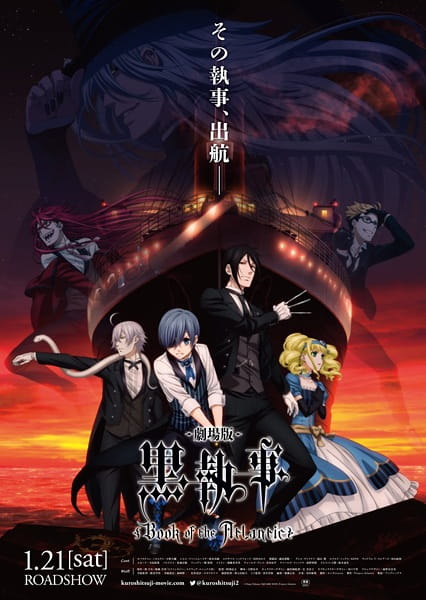
Kuroshitsuji Movie: Book of the Atlantic
- Aired: January 21, 2017
- Total Eps: 1 episode
- Streaming Platforms: Crunchyroll
- Studio: A-1 Pictures
- Director(s): Noriyuki Abe
- Original Creator: Yana Toboso
- Genres: Action, Mystery, Supernatural
Review: This movie adapts the "Luxury Liner" arc from Yana Toboso's manga, a decision that immediately signals both its strengths and its limitations. The premise is pure pulp confection: Ciel Phantomhive and his demon butler Sebastian board the maiden voyage of the Campania to investigate the Aurora Society, a mysterious group rumored to be raising the dead. What follows is a hundred-minute exercise in tonal whiplash that mostly works, provided one accepts the film on its own deliberately absurd terms.
The film's greatest asset is its willingness to commit to the bit. The idea of zombies aboard a Titanic stand-in sounds like a fever dream, yet the execution treats it with the straight-faced gothic severity the franchise demands. The horror elements are not sanitized; creature designs are grotesque, the blood flows freely, and the sheer scale of the undead horde creates a genuine sense of claustrophobic dread as the ship begins to flood. The reveal involving the Undertaker is the film's narrative centerpiece, and it lands with considerable weight for those invested in the series' long-running mysteries. The flashback to the formation of Ciel and Sebastian's contract, while disruptive to the film's momentum, provides a striking emotional anchor that contextualizes the desperation driving both characters.
The animation, however, is a persistent point of contention. While the film is undeniably handsome in its background work and the fluidity of certain action sequences—particularly one character's unexpectedly ferocious display of swordsmanship—the overall quality does not consistently exceed that of the television series. For a theatrical release, this is a notable shortfall. The fight choreography occasionally reaches impressive heights, but the visual presentation elsewhere feels constrained, as though the production never fully embraced the expanded canvas a film format allows.
Elizabeth Midford emerges as the film's most significant character revelation. Her portrayal in earlier anime iterations leaned heavily on a one-note bratty archetype, but this movie recontextualizes her entirely. The sequence in which she dispatches a hallway of zombies with a sword, followed by the revelation that her "cute" persona was a deliberate choice to avoid overshadowing Ciel, retroactively enriches a character who had been easy to dismiss. It is a rare instance of a film adaptation improving upon a character's perceived shortcomings.
The screenplay, credited to Hiroyuki Yoshino, struggles under the weight of its source material's density. The pacing is brisk to a fault, compressing a substantial manga arc into a runtime that leaves certain character beats feeling rushed. The Viscount of Druitt's involvement borders on narrative noise, and the film's climax, while visually chaotic in an appropriately apocalyptic way, resolves with a rapidity that undercuts its own stakes.
This movie is for fans of the Black Butler franchise who are seeking a darker, more action-oriented entry, and for audiences receptive to gothic horror-comedy hybrids that do not take themselves too seriously. But it is a harder sell for those expecting theatrical-grade animation throughout, and for newcomers or even veterans who may find the dense character web and series-specific lore impenetrable without prior context.

Sword Art Online Movie: Ordinal Scale
- Aired: February 18, 2017
- Total Eps: 1 episode
- Streaming Platforms: Crunchyroll
- Studio: A-1 Pictures
- Director(s): Tomohiko Itō
- Original Creator: Reki Kawahara
- Genres: Action, Adventure, Sci-Fi
Review: This movie occupies an unusual position within its franchise: an original theatrical story inserted between the second season and the later Alicization arc, built around a new technology and a mystery that ties back to the series' earliest traumas. The result is a film that understands its core audience intimately and delivers several genuine pleasures, even as it stumbles in pacing and leaves some of its most promising ideas underdeveloped.
The premise hinges on a shift from virtual reality to augmented reality. The Augma, a wearable device that overlays digital information onto the real world, has supplanted the immersive VR of earlier seasons, and its flagship game, Ordinal Scale, has become a phenomenon. The film's early stretches are at their most engaging when exploring this new dynamic. Kirito, the series' habitual VR prodigy, finds himself out of his element; Asuna, by contrast, thrives in the AR environment, and for a brief period the film flips the familiar rescue dynamic that has defined their relationship. This recalibration is welcome, even if the narrative eventually reverts to more conventional territory.
The central conflict involves SAO survivors losing their memories after encounters with boss monsters from the original death game, and Kirito's investigation into the perpetrators. The antagonist's motivations, rooted in a desire to erase a painful past, are more relatable than the franchise's usual villains, and the mystery connecting the AR idol Yuna to the broader conspiracy holds attention through the film's middle section. The augmented-reality battles themselves are a visual highlight; the climactic confrontation, in which the real world is transformed by the game's overlay, represents a genuine step up from the television series' action sequences.
Where the film falters is in its uneven pacing and its reluctance to fully commit to its own best ideas. The first half meanders, spending considerable time on exposition and light humor before the stakes crystallize. The shift back to Kirito as the indispensable hero, after briefly positioning Asuna as the capable lead, feels like a retreat from a more interesting story. And while the animation during the AR battles is often striking, the film's overall production values do not consistently exceed what the television series offered, a disappointment for a theatrical release.
The romance between Kirito and Asuna, long a divisive element of the franchise, receives more focused attention here than in most prior arcs. The film treats their relationship with a sincerity that borders on earnest, and for those invested in the couple, several scenes provide the emotional anchoring the plot requires. The music, including LiSA's theme song, effectively supports the film's more rousing moments.

Fairy Tail Movie 2: Dragon Cry
- Aired: May 6, 2017
- Total Eps: 1 episode
- Streaming Platforms: Crunchyroll
- Studio: A-1 Pictures
- Director(s): Tatsuma Minamikawa
- Original Creator: Hiro Mashima
- Genres: Action, Adventure, Fantasy
Review: This movie occupies a specific, slightly awkward place in the franchise's timeline: it slots canonically between the Avatar arc and the final confrontation with Zeref, offering one last adventure with the full guild before the endgame begins. The result is a film that understands its audience completely and delivers exactly what that audience expects—fast-paced action, familiar banter, and a plot that ties into the larger mythology—while also exposing the limitations of compressing a Fairy Tail arc into eighty-six minutes.
The premise is standard-issue MacGuffin retrieval. A traitorous minister named Zash steals the Dragon Cry, a staff imbued with the accumulated malice of dragons slain by Acnologia, and absconds to the Kingdom of Stella. Natsu and the usual team are dispatched to retrieve it, only to discover that Stella's ruler, King Animus, has his own designs on the artifact. The setup is efficient, and the film wastes little time getting the guild to Stella and into conflict with the Three Stars, the kingdom's elite military unit.
The action is where the film's budget and ambitions are most visible. Each member of Team Natsu receives a dedicated fight, with Erza and Wendy arguably getting the most dynamic sequences. Natsu's climactic confrontation with Animus carries genuine weight, particularly because it hinges on a revelation about his nature that the series had been building toward for hundreds of episodes. The moment his body partially transforms, and Animus recognizes him as E.N.D. is the film's narrative centerpiece, and it lands with the appropriate sense of dread and inevitability. The animation during these sequences is solid, though it unevenly distributes its resources—some fights feel perfunctory while others receive visibly more care.
The film's most significant structural problem is its pacing. The plot moves from capture to escape to recapture to final confrontation with almost no breathing room. The guild is captured and escapes with barely a struggle; Natsu locates Lucy and the staff with minimal obstacle; the Three Stars are dispatched in quick succession. This briskness keeps the film from dragging, but it also prevents any of the new characters from making an impression. Sonya, the film's original female lead, exists primarily as a vessel for Animus's secret and a tool for the plot; her eventual agency arrives too late to matter. Zash, despite a menacing introduction, is ultimately disposed of as a secondary threat to make way for the real villain.
The treatment of Lucy remains a persistent issue. She is captured, strung up, and subjected to humiliation more than once, and the film's most lavishly animated sequence is her bikini dance to distract Zash—a moment that feels less like character agency and more like the production prioritizing fan service over narrative coherence. Lucy has proven herself capable in the series proper, so her relegation to damsel here is a regression that the film never justifies.
What works, ultimately, is the film's integration into the larger canon. The post-credits scene, in which Acnologia destroys the ribbon that was once Sonya's, and Zeref declares that his battle with Natsu is imminent, functions as a bridge between the film and the final arc. For those invested in the series' mythology, this movie offers a worthwhile side story that enriches the stakes of what follows. For those seeking a standalone film, it is a serviceable but unremarkable action fantasy that assumes a level of familiarity with its characters that newcomers will not possess.

Nanatsu no Taizai Movie 1: Tenkuu no Torawarebito
- Aired: August 18, 2018
- Total Eps: 1 episode
- Streaming Platforms: Netflix
- Studio: A-1 Pictures
- Director(s): Noriyuki Abe (Chief), Yasuto Nishikata
- Original Creator: Nakaba Suzuki
- Genres: Action, Adventure, Fantasy
Review: This movie arrives with a considerable advantage: an original story penned by manga creator Nakaba Suzuki himself, rather than a studio invention grafted onto the franchise. That pedigree promises a side adventure that feels authentically of a piece with the series. What the film actually delivers is a competent but deeply uninspired outing that recycles well-worn shonen film tropes, fields antagonists of negligible threat, and ultimately feels less like a theatrical event than a stretched television episode with a marginally bigger budget.
The premise is standard-issue MacGuffin-driven adventuring. To celebrate the king's birthday, the Sins set out to find the phantom ingredient "sky fish," a quest that strands Meliodas and Hawk in a floating Sky Palace inhabited by winged people preparing a ritual to seal a beast that awakens every three thousand years. Naturally, the Demon Clan's Six Knights of Black arrive to break the seal and threaten the inhabitants. It is a structure so familiar it practically assembles itself, and the film makes no attempt to complicate it. The floating island populated by winged beings invites immediate and unavoidable comparisons to One Piece's Skypiea arc, and the film does little to distinguish its version beyond the particulars of its original characters.
The most significant structural failure lies with the antagonists. The Six Knights of Black, led by Bellion, are introduced as a Demon Clan army whose leader's strength is said to rival the Ten Commandments. This reputation collapses almost immediately upon contact. The Sins dispatch them with a swiftness that drains the film of any sustained tension; there is never a moment where the outcome feels in doubt, never a sequence where the heroes are genuinely pushed. The climactic beast, once unsealed, is similarly inert—large and loud but devoid of presence. For a franchise whose television arcs had cultivated a genuine sense of escalating threat, the film's conflict registers as perfunctory.
The original characters fare no better. Sorada and Ellatte, the winged youths whose plight ostensibly anchors the emotional stakes, exist primarily to facilitate the Sins' heroics. Ellatte's resemblance to Elizabeth is noted but never meaningfully explored, and Sorada's quest for a legendary protector resolves without leaving an impression. The film's one gesture toward thematic weight—a line about losing sight of what matters while clinging to rules—lands with the soft thud of a fortune cookie.
What the film does offer is the baseline pleasure of seeing the ensemble together. The returning cast, from Yuki Kaji's Meliodas to Tomokazu Sugita's Escanor, slip back into their roles with ease, and the character interactions carry the warmth of familiarity. Hiroyuki Sawano's score provides the requisite bombast, though it rarely ascends to the heights of his television work. The animation is serviceable but uneven, with action sequences that lack the fluidity and impact of the series' stronger episodes; the overall impression is of a production that met expectations rather than exceeded them.
This movie is not a disaster. It is simply unnecessary—a film that exists because the franchise was popular enough to warrant one, not because it had a story that demanded to be told. For devoted followers hungry for any additional time with the Sins between television seasons, it passes the time adequately. For anyone seeking a compelling standalone fantasy adventure, the Sky Palace offers little worth the climb.

Uta no☆Prince-sama♪ Movie: Maji Love Kingdom
- Aired: June 14, 2019
- Total Eps: 1 episode
- Streaming Platforms: -
- Studio: A-1 Pictures
- Director(s): Jōji Furuta (Chief), Tomoka Nagaoka
- Original Creator: Broccoli
- Genre: -
Review: This movie makes a decision that is either admirably pure or fundamentally alienating, depending on one's relationship to the franchise: it has no plot. None. The eighty-four-minute runtime is devoted entirely to an animated concert featuring the three idol groups—ST☆RISH, QUARTET NIGHT, and HE★VENS—performing on stage, with brief interstitial banter between songs and nothing else. There is no crisis to resolve, no romantic development, no narrative arc beyond the progression of the setlist. For audiences who have followed these characters across multiple television seasons, this is an invitation to witness them as idols rather than as story participants. For anyone else, it is a very expensive music video.
The film's central achievement is technical. A-1 Pictures renders the concert with a level of polish and continuity that mimics the experience of a live performance, complete with cheering crowds, penlights, and camera work that swoops and cuts as though capturing a real stage. The dance choreography is consistently impressive, and the CGI used for full-group numbers, while not flawless, is integrated more smoothly than in many comparable productions. The setlist draws from the franchise's extensive catalog, with group numbers, solo showcases, and shuffle units that mix members across the three groups, offering variety within the concert format. The music itself is the film's raison d'être, and for audiences who find the UtaPri sound appealing, the selection delivers.
The interstitial moments—brief conversations and backstage-style interactions among the idols—function as the closest thing to character work the film offers. These sequences are described as faithful to the characters' established personalities and frequently amusing, providing a necessary breather between performances. The decision to include them prevents the film from becoming an unbroken wall of sound, though audiences seeking substantial development will find them insufficient. The female protagonist, Haruka, whose compositions underpin the franchise's premise, appears only in the credits, a choice that has drawn criticism from those hoping for more closure on her relationships.
The film's commercial and critical reception in Japan was notably strong, with satisfaction rankings placing it at the top of major review aggregators and a total box office exceeding seventeen billion yen. Much of this success was attributed to the "Maji Love Live Screening" format, in which audiences were encouraged to cheer, sing along, and use penlights as though attending an actual concert, a participatory experience that transformed the theatrical viewing into something closer to a live event. This context matters: this movie was designed not as a film to be watched passively but as an experience to be shared collectively, and its effectiveness is inseparable from that mode of engagement.
What the film does not attempt is accessibility. It assumes complete familiarity with the characters, their group dynamics, and the franchise's musical identity. There is no introduction, no explanation, no effort to welcome newcomers. This insularity is not a flaw in execution but a deliberate narrowing of purpose. This movie is a gift to the already converted, and it executes that gift with considerable craft. Whether that gift has value depends entirely on whether one was already in the kingdom.

High School Fleet Movie
- Aired: January 18, 2020
- Total Eps: 1 episode
- Streaming Platforms: -
- Studio: A-1 Pictures
- Director(s): Yuu Nobuta (Chief), Jun Nakagawa
- Original Creator: Takaaki Suzuki
- Genre: Action
Review: This movie arrives three years after the television series and its two-episode OVA, and it carries the weight of a franchise that never quite achieved the breakout success of its obvious genre peers. The film, produced by A-1 Pictures with Jun Nakagawa directing and Yuu Nobuta returning as chief director, sets its story three months after the OVA, as the crew of the Harekaze II prepares to host a festival for rival maritime schools before a hijacking plunges them into a familiar brand of nautical crisis. What follows is a film that delivers the franchise's signature blend of earnest girlhood and naval spectacle, but does so with a structural unevenness that prevents it from fully capitalizing on its theatrical format.
The film's opening act is devoted to festival preparation and character interactions, a choice that will feel either charming or interminable depending on one's investment in the cast. The central emotional thread involves Mashiro Munetani receiving a recommendation to become captain of the Hiei, a development that creates tension with Akeno Misaki and forces the pair to navigate a shift in their relationship. This material is handled with the franchise's usual sincerity, and the resolution of their conflict provides the film's most grounded emotional beat. However, the festival sequences consume a disproportionate amount of the runtime, leaving the actual crisis—a floating water purification plant and sea fortress hijacked by pirates—to unfold in a compressed second half that rushes through its stakes.
The action, when it arrives, is the film's strongest asset. The naval battles are rendered with a clear affection for the machinery involved, and the climactic assault on the fortress features a sequence in which the Harekaze II infiltrates through a breach opened by the combined firepower of four Yamato-class ships. This set piece delivers the kind of large-scale spectacle that justifies the film's existence, even if the tactical logic occasionally strains credulity. The infiltration of the fortress itself, with its close-quarters combat and hand signals, has been noted for its procedural authenticity, though the animation quality during these sequences is inconsistent, with character art occasionally faltering in ways that distract from the momentum.
The film's supporting cast, including the crews of the other maritime schools, is introduced with fanfare but given little to do beyond firing their guns in formation. A newcomer, Susan Reyes, is positioned as a sympathetic figure coerced by pirates, but her arc resolves without meaningful consequence. The Blue Mermaids, the franchise's elite peacekeeping force, function largely as backup for the high schoolers who remain the story's focus. The result is a film that feels overpopulated yet underfocused, gesturing toward a larger world without committing to exploring it.
For audiences already invested in the Harekaze crew, the film offers a satisfying reunion and a handful of genuinely thrilling naval sequences. For those seeking a standalone entry or a more disciplined narrative, it is a harder sell—a film that spends too long at the festival and too little in the fray, leaving the impression of an OVA that was expanded to feature length rather than a story conceived for the big screen.

Omoi, Omoware, Furi, Furare
- Aired: September 18, 2020
- Total Eps: 1 episode
- Streaming Platforms: -
- Studio: A-1 Pictures
- Director(s): Toshimasa Kuroyanagi
- Original Creator: Io Sakisaka
- Genres: Drama, Romance
Review: I go into this movie expecting a gentle shoujo romance, and what I get is a film that is constantly, visibly straining against its own runtime. The story follows two girls—Yuna, a dreamer who believes in destined love, and Akari, a pragmatist who treats romance as trial and error—and the two boys who complicate their lives: Rio, Akari's stepbrother with a secret, and Kazuomi, Yuna's oblivious childhood friend. The setup is classic Io Sakisaka, full of tangled feelings and soft pastel melancholy. But almost from the first scene, I can feel the film racing through material that clearly deserved more room to breathe.
The animation is genuinely lovely. A-1 Pictures gives the film a warm, luminous palette, and the character designs are expressive and appealing. There are moments—a shared glance, a quiet walk home—where the visual storytelling lands with real tenderness. The theme song "Gravity" by BUMP OF CHICKEN is also well-chosen, its gentle swell matching the film's emotional register. On a purely aesthetic level, this is a pleasant film to sit with.
But the pacing is relentless. The film compresses a twelve-volume manga into under two hours, and the seams show everywhere. Characters confess feelings and then pivot to new attachments with a speed that feels less like adolescent fickleness and more like an editing room necessity. Rio's internal conflict, which should be the emotional backbone of the story, is reduced to a handful of brooding looks and a rushed explanation. Yuna's growth from passive romantic to someone who can articulate her own desires happens in fits and starts, her internal monologue—so crucial to the manga's appeal—largely absent. I find myself understanding what the characters are feeling because the plot tells me, not because the film has earned it.
And yet. There is something about the film's sincerity that keeps me from dismissing it entirely. The four leads are played with a genuine, unforced warmth by their voice actors, and the film's refusal to villainize anyone—to let every character be sympathetic even when they make messy choices—feels true to the messy reality of being sixteen and not knowing what you want. The ending, which brings all four together in a way that acknowledges how much they've hurt each other without pretending the wounds are fully healed, lands with a quiet grace.

Sword Art Online: Progressive Movie - Hoshi Naki Yoru no Aria
- Aired: October 30, 2021
- Total Eps: 1 episode
- Streaming Platforms: -
- Studio: A-1 Pictures
- Director(s): Ayako Kōno
- Original Creator: Reki Kawahara
- Genres: Action, Adventure, Fantasy
Review: I go into this movie with a fair amount of skepticism. The original SAO anime was a defining show for a generation of fans, but it was also a mess of rushed pacing and skipped floors. The Progressive novels were supposed to fix that, and this film is the first real attempt to do so. What I find is a movie that is genuinely trying to be a better version of the story I remember, and for the most part, it succeeds.
The biggest change is the perspective. Instead of Kirito, the film centers on Asuna. I watch her go from a terrified girl who has never played an MMO to someone who refuses to be a victim. Her arc is the spine of the movie, and it's handled with a care that the original series rarely afforded her. The scene where she breaks down in a dungeon, alone and overwhelmed, is the emotional anchor. When she meets Kirito, their partnership doesn't feel like a romance imposed by plot; it feels like two people who found each other in a nightmare and decided to survive together.
The animation from A-1 Pictures is a significant step up from the TV series. The fights have weight and clarity, and the dungeon environments feel genuinely oppressive. The boss fight on the first floor is the centerpiece, and it delivers—the choreography is sharp, the stakes are clear, and the moment when Asuna steps up to deliver the final blow is genuinely cathartic. The soundtrack by Yuki Kajiura is as strong as ever, and the new arrangements of familiar themes land with a nostalgic punch.
What holds me back from fully embracing it is the lingering sense that this is still a prologue. The film covers only the first floor of Aincrad, and it ends with the promise of more to come. For anyone who has been waiting for Progressive to deliver on its promise of a floor-by-floor retelling, this is both exciting and frustrating. I want the whole story, not just the first step. But as a first step, it's a confident one.

Uta no☆Prince-sama♪ Movie: Maji Love ST☆RISH Tours
- Aired: September 2, 2022
- Total Eps: 1 episode
- Streaming Platforms: -
- Studio: A-1 Pictures
- Director(s): Chika Nagaoka
- Original Creator: Broccoli
- Genre: -
Review: I go into this movie expecting a concert film, and that is precisely what I get—sixty-five minutes of the seven-member group performing, with no plot, no dialogue scenes beyond brief stage banter, and no pretense of being anything other than a virtual live experience. What surprises me is how much more assured this feels compared to its predecessor, Maji Love Kingdom. The decision to narrow the focus to ST☆RISH alone, rather than juggling three groups, gives the film a coherence that the previous concert movie lacked.
The improvement is most visible in the staging and camera work. The full-CG performances are more ambitious here, with solo numbers, unit combinations, and full-group sequences that each receive distinct visual treatment. The "travel" theme allows each member's solo to evoke a different part of the world, which gives the setlist a structure beyond simply cycling through songs. The camera swoops and dives in ways that mimic a real concert film but occasionally pushes past what a physical camera could achieve—a deliberate embrace of animation's freedom that makes the experience feel distinctly anime rather than a simulation of reality.
The body language of the characters is rendered with surprising attention to physicality. The CG models convey weight and muscle in ways that make the performances feel grounded, even when the choreography itself is impossible. There are moments where the motion feels slightly unnatural—a stiffness in certain dance sequences that betrays the digital construction—but these are brief interruptions rather than persistent flaws.
What keeps me at arm's length is the same thing that defines the experience: it is entirely dependent on familiarity. The film offers no entry point for someone who does not already know these characters or their music. The interstitial banter assumes affection rather than building it. The emotional climaxes are built on songs that carry weight only if you have heard them before. This is not a criticism of execution but of scope—this movie knows exactly who it is for and makes no apology for that.

Sword Art Online: Progressive Movie - Kuraki Yuuyami no Scherzo
- Aired: October 22, 2022
- Total Eps: 1 episode
- Streaming Platforms: -
- Studio: A-1 Pictures
- Director(s): Ayako Kōno
- Original Creator: Reki Kawahara
- Genres: Action, Adventure, Fantasy, Romance
Review: I go into this movie hoping for a continuation of what Aria of a Starless Night started: a version of Aincrad that feels lived-in, where the stakes are real and the characters have room to breathe. What I get instead is a film that feels caught between two identities, unsure whether it wants to be a self-contained cinematic chapter or simply the next installment in a long-form adaptation. The result is a movie that, for all its polished animation and a handful of genuinely excellent sequences, left me feeling like I had watched a very expensive episode of television rather than a film.
The central conflict is promising enough. Kirito and Asuna find themselves caught between two rival guilds, the Aincrad Liberation Squad and the Dragon Knights Brigade, whose feud threatens to derail the entire clearing effort. There's a mysterious figure pulling strings behind the scenes, and the tension between cooperation and self-interest gives the story a thematic spine that the original series often lacked. The problem is that the film doesn't commit to this conflict with any real urgency. The first twenty minutes are a slog—a lengthy dinner scene followed by a side quest involving a sword-stealing monster that feels like padding rather than setup. By the time the actual plot kicks in, I had already checked out once.
What brings me back is the midsection. There's a duel between Asuna and the information broker Argo in a hot spring resort that is legitimately well-animated, quick and sharp and fun in a way the opening completely failed to be. The fifth-floor boss fight at the end delivers the kind of spectacle I expect from an SAO movie, and Yuki Kajiura's score, when it finally gets to do something interesting, reminds me why I keep coming back to this franchise despite its flaws. The animation during these sequences is fluid and confident, and for a few minutes, the film feels like it might justify its existence.
But the story never coheres. The guild conflict resolves with a neatness that feels unearned, the mysterious manipulator is barely developed, and the emotional throughline involving Mito—a character created for these films and explicitly not part of the source material's canon—gets tied off with a bow that feels more like a production necessity than a narrative conclusion. I understand the impulse to give Asuna a friend who isn't Kirito, and Mito has been a welcome addition, but her arc here feels rushed, as though the filmmakers realized they needed to close that thread before moving on to the next floor.
What lingers, ultimately, is the sense of a film that is less than the sum of its parts. The pieces are there—the animation, the music, the relationship between Asuna and Kirito that remains the franchise's most reliable asset—but they don't assemble into something that feels essential. This is a bridge, and it knows it. Whether that bridge is worth crossing depends entirely on how invested you already are in reaching the other side.

Kaguya-sama wa Kokurasetai: First Kiss wa Owaranai
- Aired: December 17, 2022
- Total Eps: 1 episode
- Streaming Platforms: -
- Studio: A-1 Pictures
- Director(s): Mamoru Hatakeyama
- Original Creator: Aka Akasaka
- Genres: Comedy, Drama, Romance
Review: As a writer, I approach this with the awareness that it is doing something structurally risky: it takes the climax of a three-season romantic comedy—the kiss—and insists on examining the messy, unglamorous aftermath rather than letting the credits roll on a tidy resolution. The result is a film that functions less as a standalone feature than as a concentrated burst of character work, a ninety-minute excavation of the insecurities that the preceding seasons had only hinted at. It is not always comfortable to watch, and that is precisely the point.
The film picks up immediately after the culture festival kiss, with Kaguya horrified to realize she may have gone further than intended and Shirogane paralyzed by the ambiguity of their status. What follows is a week-long unraveling, rendered through the series' signature visual excess. Kaguya's psyche fractures into competing personas, with "Ice Kaguya" seizing control and pursuing a course of aggressive assertiveness that is less seduction than a desperate attempt to force a resolution. Shirogane, meanwhile, spirals into exhaustion, his composure cracking under the weight of his conviction that he must be perfect to stand beside her. The film's central insight is that the war they had been waging was never really about making the other confess. It was about avoiding the terror of being seen as insufficient.
The Christmas Eve sequence, in which Shirogane offers an imperfect gift—a kendama, of all things—and then tries to retreat before giving it, is the film's emotional apex. Ice Kaguya's pursuit, her insistence that she wants to know the real Shirogane regardless of his flaws, and the quiet kiss they share in contrast to the festival's grand spectacle, resolve the arc not through conquest but through mutual acceptance. The title's promise—a first kiss that never ends—is fulfilled not as a romantic fantasy but as a statement about what it means to choose someone repeatedly, imperfectly, without the certainty of a script.
From a craft perspective, the production values are consistent with the television series, which is both a compliment and a limitation. Shaft's direction under Mamoru Hatakeyama retains its wit and visual invention, but the film does not feel meaningfully more ambitious than a strong arc of the show. The secondary cast—Ishigami, Iino, Chika—are largely sidelined, their threads acknowledged but not developed, which leaves the film feeling narrower than the ensemble work that made the series so beloved. The decision to release this material theatrically rather than as a television special is understandable commercially but does the pacing no favors.
What I admire most, as someone who thinks about narrative structure, is the film's refusal of the easy exit. It could have ended with the kiss. It could have skipped to the wedding. Instead, it insists that love is work, that the person you choose is not a prize to be won but a question to be answered again and again. That is a harder story to tell than a confession, and a harder one to watch. It is also, I think, the truer one.

Kagami no Kojou
- Aired: December 17, 2022
- Total Eps: 1 episode
- Streaming Platforms: -
- Studio: A-1 Pictures
- Director(s): Keiichi Hara
- Original Creator: Mizuki Tsujimura
- Genres: Drama, Fantasy, Mystery
Review: As a writer, I approach this movie with the awareness that it is attempting something structurally difficult: adapting a novel about seven traumatized children into a single two-hour film, while balancing the interiority of its protagonist against the need to give six supporting characters enough weight to justify their presence. The result is a work that succeeds at the level of theme and atmosphere but stumbles at the level of ensemble construction, leaving several of its most interesting threads dangling by the time the credits roll.
The premise is elegant in its simplicity. Kokoro, a middle schooler unable to attend school after a bullying incident, discovers that her bedroom mirror is a portal to a castle where six other troubled children gather. A girl in a wolf mask informs them that a hidden key will grant one of them a wish, but they must find it within a year, and breaking the rules carries a lethal penalty. What follows is less a fantasy adventure than a slow, patient accumulation of small moments—shared meals, board games, awkward silences—as these children learn to exist in the same space without hurting each other. The fantasy is a frame; the healing is the point.
The film's greatest strength is its treatment of Kokoro's trauma. The scenes depicting her inability to leave her room, her fear of her parents' disappointment, and her gradual realization that she is not alone in her suffering are rendered with a restraint that avoids melodrama. The teacher who reaches out to her, Mrs. Kitajima, is handled with particular care; she is not presented as a savior but as a lifeline, someone who offers support without demanding that Kokoro be fixed on a schedule. The film understands that healing is not linear, and it extends that understanding to its protagonist with genuine compassion.
Where the film falters is in its allocation of attention. With seven children and a two-hour runtime, the math simply does not work. Kokoro receives the bulk of the development; Aki and Rion emerge as secondary figures with identifiable arcs; the remaining four—Fuuka, Ureshino, and two others who barely register—are reduced to sketches. Their traumas are revealed in a rushed sequence of flashbacks near the film's climax, a structural choice that feels less like revelation and more like a checklist being completed before the credits. One character's backstory involves a familial sexual assault attempt, a detail dropped into the narrative with no time to explore its implications or its aftermath. The film wants to honor these children's pain, but it cannot give that pain the space it deserves.
The central mystery—why these seven were chosen, what the castle is, who the Wolf Queen truly is—resolves with a twist that ties the group together across time in a way that is clever in conception but underdeveloped in execution. The connections between the characters, when revealed, carry emotional weight only for those who have received enough screen time to matter. The others remain ciphers, their presence in the castle explained but not felt. A longer format—a series, perhaps—could have given each child the room to become a person rather than a case study.
The production from A-1 Pictures is solid without being exceptional. The castle backgrounds are rendered with an appropriate sense of scale and wonder, and the contrast between the muted realism of Kokoro's home life and the storybook quality of the fantasy space is effective. The music is serviceable, though it rarely rises to the level of the emotional beats it accompanies. The animation does not attempt spectacle; it aims for intimacy, and for the most part, it achieves it.
What lingers, as a writer, is the sense of a film that understood its thesis but not its structure. This movie argues that trauma isolates, and that connection—even among strangers who share nothing but their loneliness—can be the first step toward something like recovery. That argument is made with sincerity and without condescension. But a film with seven protagonists cannot afford to treat six of them as supporting evidence for the first. The castle had room for all of them. The screenplay did not.

Uta no☆Prince-sama♪ Movie: Taboo Night Kisses
- Aired: May 9, 2025
- Total Eps: 1 episode
- Streaming Platforms: -
- Studio: A-1 Pictures
- Director(s): Jōji Furuta (Chief), Akiko Seki
- Original Creator: Broccoli
- Genre: -
Review: I walked into this movie knowing exactly what the franchise promises: a sixty-minute animated concert film built for the faithful, a chance to watch Quartet Night strut across a screen in costumes too elaborate for reality. What I found was a production that understands its audience with almost ruthless precision, yet leaves me wondering whether understanding an audience and serving it well are the same thing.
The premise, such as it is, frames the four members of Quartet Night as thieves who steal a set of jewels and transform into princes ruling four forbidden realms. It is nonsense, but it is deliberate nonsense—an excuse to string together solos, duets, and group numbers across a fantasy backdrop. The opening minutes establish this without apology. There is no narrative to follow, only a visual and musical assault that assumes you are here for the idols, not the story.
And visually, it delivers. The motion-capture choreography gives the performances a fluidity that hand-drawn animation often struggles to match, and the costume design is nothing short of extravagant. Camus in particular benefits from the CG treatment, his stage presence rendered with a cold, sculptural precision that suits the character. For a film that exists primarily as a theatrical substitute for a live concert, the illusion mostly holds. The encore segment, where the idols finally speak directly to the audience, is the only moment the film exhales—and it is easily the most affecting.
But the music, for a music-first project, is the weak link. The songs blur together in a wash of fast tempos and heavy production, with vocals that sit too low in the mix to leave an impression. Individual character singles from the franchise have demonstrated genuine range; here, the arrangements feel rushed, as if the visual concepts were finalized before anyone thought about whether the hooks were memorable. I left unable to hum a single melody.
The runtime—barely under an hour—exacerbates this. There is no room for the quieter interstitial moments that made previous concert films breathe, no space for the characters to exist outside the choreography. What remains is a relentless spectacle that, for all its technical competence, feels oddly hollow. The film trusts that affection for these four characters will carry the experience. For the devoted, it probably does. For anyone else, it is a beautifully rendered empty room.
I wanted to be swept away. I was impressed, occasionally, by the craft on display. But the songs did not stay with me, and neither did the fantasy. This movie knows exactly what it is. I am less certain it knows what it could have been.

Kusunoki no Bannin
- Aired: January 30, 2026
- Total Eps: 1 episode
- Streaming Platforms: -
- Studios: A-1 Pictures, Psyde Kick Studio
- Director(s): Tomohiko Itō
- Original Creator: Keigo Higashino
- Genre: -
Review: I came to this movie carrying the weight of a name: Keigo Higashino, the master of quiet, devastating human mysteries, adapted into anime for the first time. The premise alone promised something that anime rarely attempts with sincerity—a story built not on spectacle but on regret, on people carrying unfinished conversations to a tree rumored to grant wishes. What I found was a film that understands the shape of Higashino's melancholy but struggles to translate its texture into animation.
The story opens with Reito Naoi at his lowest, unfairly dismissed from his job and lashing out in a way that lands him in trouble. He is rescued by an estranged aunt, Chifune, who installs him as the keeper of a mysterious camphor tree. Visitors come, each bearing a wish, and Reito's task is simply to listen. It is a premise that could have been a quiet triumph: a chamber piece about the stories people tell themselves to survive their own choices.
For stretches, it works. The film leans into human drama rather than action, and the decision to cast live-action actors in the voice roles—Takahashi Fumiya as Reito, Amami Yuki as Chifune—gives the performances a lived-in quality that veteran voice actors sometimes lack. Director Tomohiko Ito, whose work on Erased demonstrated a feel for small emotional gestures, brings a restrained hand to the material. The theme song by Uru, composed by back number, settles over the ending with the right kind of ache.
But animation is a medium of expression, not merely of storytelling, and here the film feels oddly static. The camphor tree, which should be a character in its own right—ancient, indifferent, perhaps listening—renders as little more than a well-painted backdrop. The supernatural element, the quiet magic of a wish-granting tree, is treated with such restraint that it evaporates. What remains is a series of conversations that might have been just as effective in live-action, stripped of the visual language that justifies the anime form.
The emotional architecture is sound, but the pacing betrays it. At 113 minutes, the film rushes through the visitors' stories, giving each regret only a handful of scenes before moving to the next. Higashino's prose lingers; it lets discomfort settle. The film does not trust its audience to sit in the quiet. I wanted to feel the weight of each wish, the specific gravity of each person's failure, and instead I was hurried along to the next gentle lesson.
And yet I cannot call it a failure. There are moments—Chifune's guarded grief, the way Reito's own shame slowly loosens its grip—that carry real resonance. The film knows that the tree is not the point. The point is that people need a place to put their hope, and sometimes that place is enough. That idea is beautiful, and the film believes it. I just wish it had given itself more room to breathe.
This is a film that reaches for the quiet sublime and grasps something adjacent to it. It is not the Higashino adaptation that anime deserved, not yet. But it is one that tries, and in a landscape of louder, emptier spectacles, that effort lingers longer than its flaws.
A-1 Pictures has continuously produced a wide variety of animated films and programs that enthrall audiences throughout the world, ranging from poignant dramas to action-packed fantasy and witty romantic comedies. Their status as a dominant force in the anime business has been cemented by their dedication to producing high-caliber animation and gripping narratives, guaranteeing that every viewer will find something memorable in their impressive body of work.
Source: MyAnimeList


Comments
Post a Comment